
We Will Not Back Down!
2025/1.
Introduction
Under the Flags
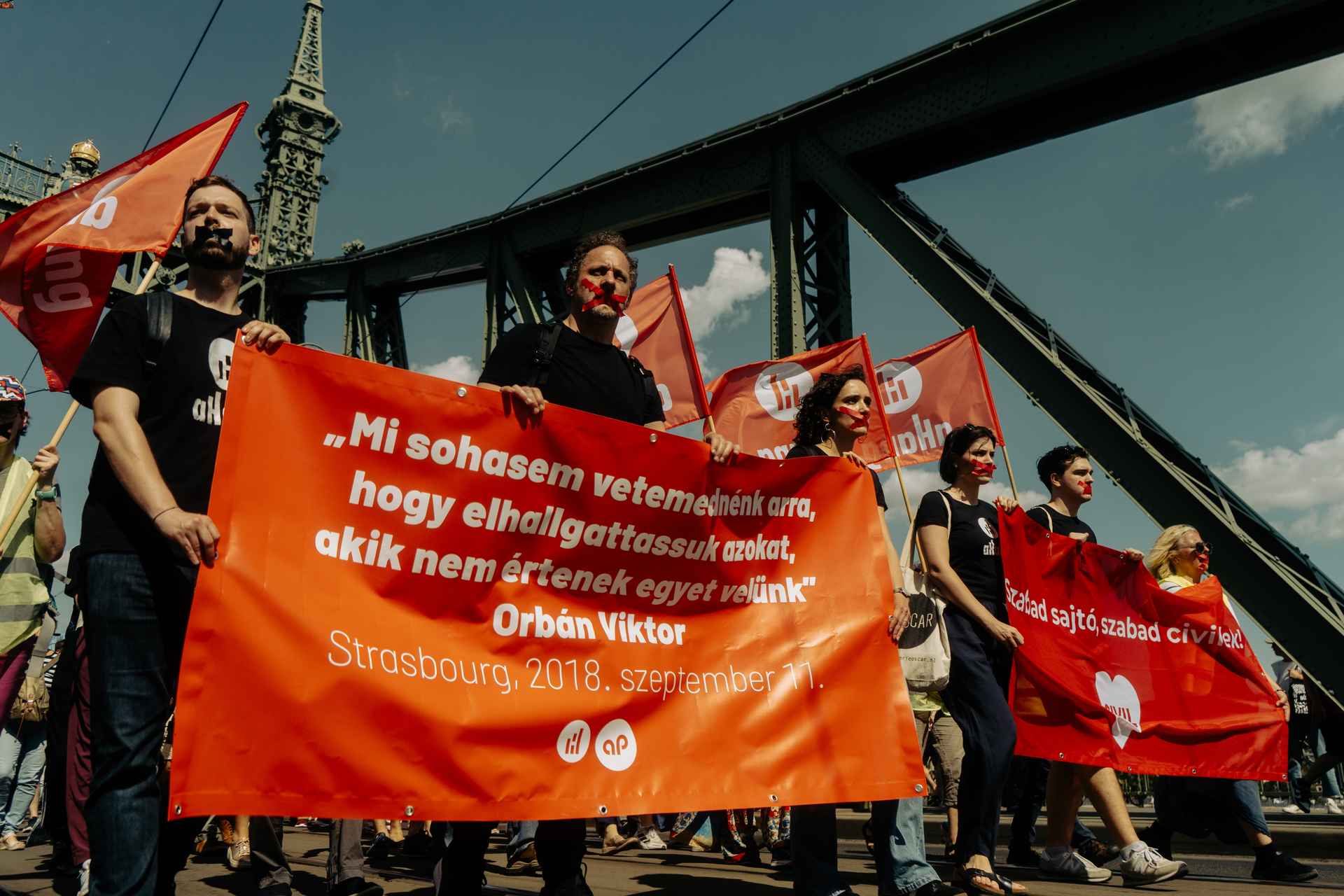
When thousands of us marched silently across Liberty Bridge, with our mouths taped shut, in dignity, under a sea of aHang flags, it wasn’t only public life that shifted—it was something within us, too.
We lived through iconic moments together: even in silence, our seriousness and determination were tangible. They gave our demonstration such strength and elevation that it shone through in every recording and made headlines in the international press.
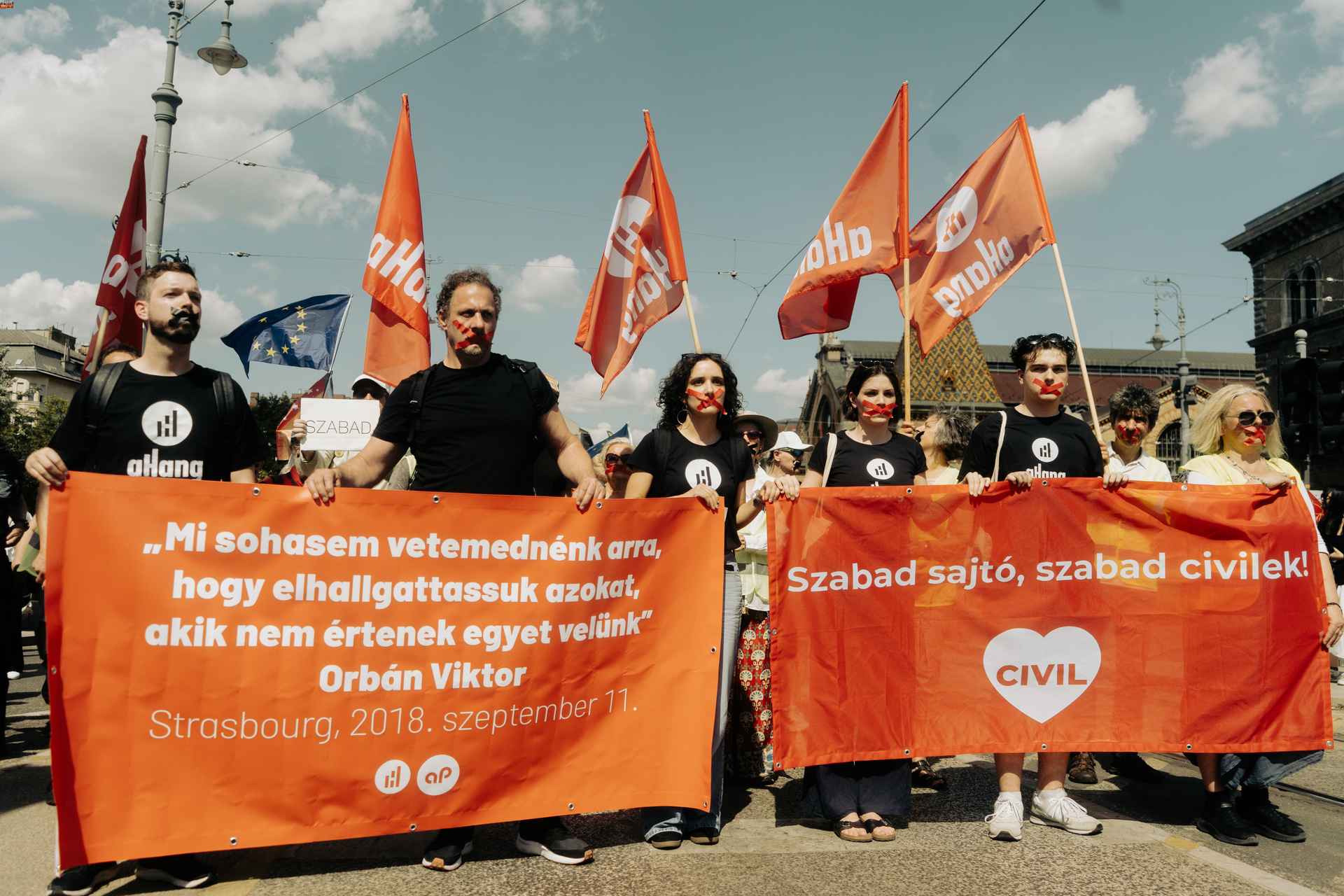
Yes, we were strong. We drew strength from the hundreds of activists lined up behind the flags at the forefront of the march, and also from the 17 local demonstrations organized across the country at the same time by our county-level groups, the aPonts. Years of work have come to fruition in those weeks — in those very moments, aHang's network is truly becoming national.
Symbolically, this could not have come at a more crucial time. The draft law prepared to silence civil society and independent media struck like lightning, shocking many. While some were already aware of its significance and acted within their own communities, aHang mounted a coordinated, rapid, and powerful resistance across towns and cities nationwide—proving that this was not just an isolated, Budapest issue, but a national cause.
This energy had already been present in our nationwide organizing before the silencing bill was introduced. Over the past six months, our local groups grew by leaps and bounds. They kept key local issues on the agenda, shaped public discourse and the media with countless actions, and won significant victories month after month.
All this is a tremendous confirmation for us, and it drives us toward even faster growth. In the coming months, we will launch new aPonts in additional locations, and by 2026 we will be present in the majority of Hungarian counties.
We believe this is the path we must follow. Only through systematic local organizing can we return public affairs into the hands of the people, and ensure that no one in Hungary can ever again wield unchecked power.
Máté Varga,
Executive Director, aHang
If you agree with us, and if you find the work and achievements summarized in this publication convincing, please contribute to the salaries of our new county coordinators.
Successes
Successes
From Attack to Retreat
On May 13, just before midnight, Fidesz MP János Halász submitted the so-called “transparency” bill of silencing, which—true to Orbán’s promises—was meant to be part of the “spring cleanup,” that is, silencing critical voices. According to the draft law, the so-called Office for the Protection of Sovereignty could propose that the government place on a register those organizations it deemed a threat to Hungary’s sovereignty. These organizations would then be barred from receiving donations through the 1% of personal income tax allocations; they could accept foreign funding only with the permission of Hungary’s financial intelligence unit, that is, the National Tax and Customs Administration (NAV); their directors, founders, and supervisory or control board members would be required to file asset declarations, just like MPs; and both the organizations and their leaders would be classified as politically exposed persons (PEPs). The goal was crystal clear: to silence critical and independent media outlets and civil society organizations.
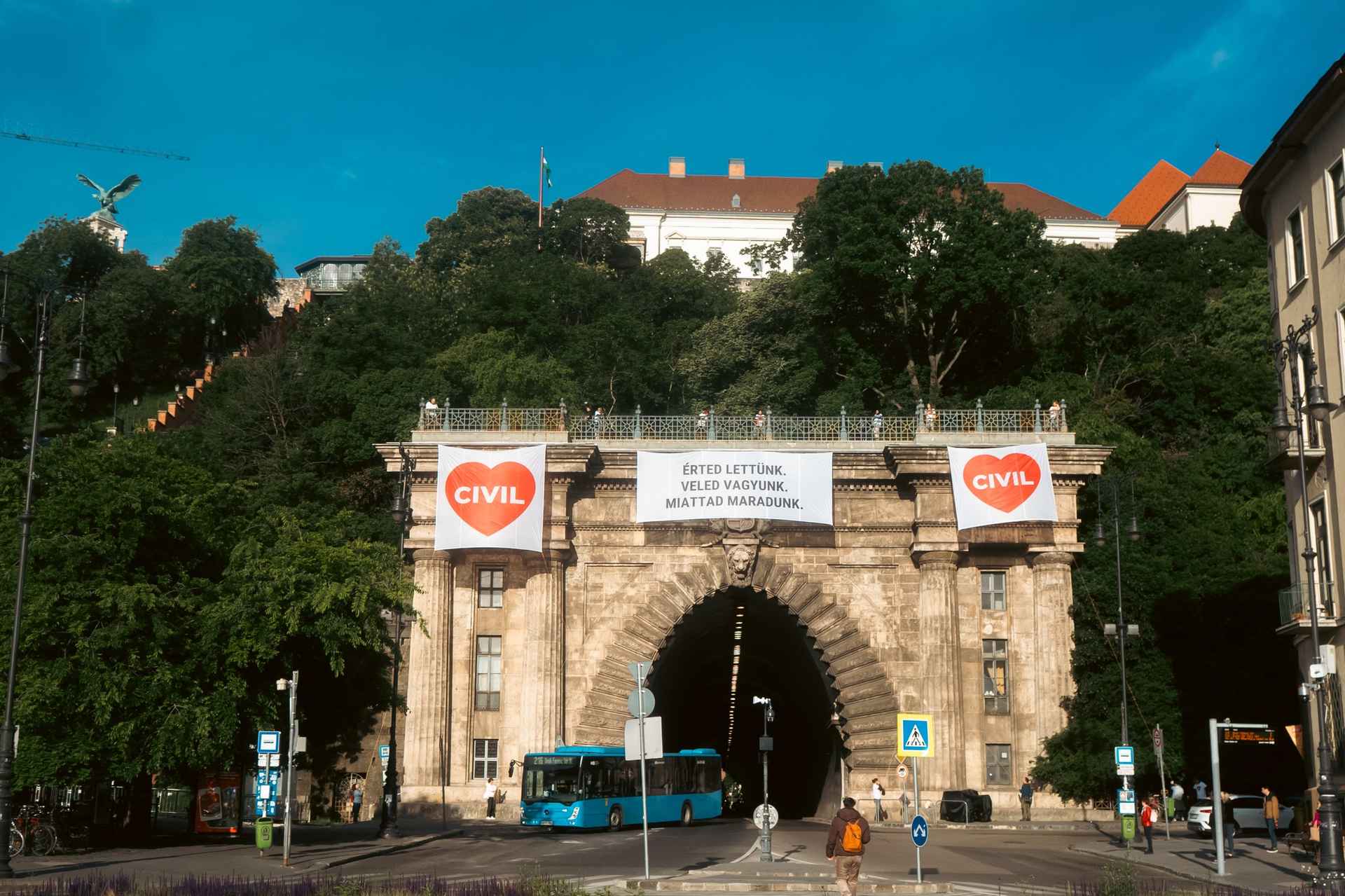
An unprecedented wave of unity began. We joined the joint statement initiated by Civilizáció, in which hundreds of civil society organizations and editorial teams declared: No country was ever built on blacklists. Shortly after, we took part in a spectacular action in Budapest, where we unfurled three massive banners at the Castle Tunnel. The banners displayed the civil heart symbol and the slogan of our joint stand: "We were created for you. We are with you. We remain because of you."
Fidesz turned the propaganda machine up to full speed. Leading politicians implicitly threatened journalists, suggesting the law would affect them too, all while insisting this was not political revenge but simply about "transparency in public life."
We also launched a protest petition , which was signed by nearly 50,000 people raising their voices against the silencing of the independent press and civil society. But when we saw that events were once again being organized only in the capital, we decided to take people to the streets across the whole country. Together with our local groups, the aPonts, we announced a series of demonstrations.
Within 11 days we organized protests in 17 towns and cities nationwide.
We were present in Békéscsaba, Kisvárda, Szentes, Nyíregyháza, Miskolc, Szolnok, Salgótarján, Orosháza, Szeged, Pásztó, Tiszaújváros, Makó, Gyula, Budapest, Kazincbarcika, Hódmezővásárhely, and Veszprém.
We stood up even in places where the authorities did not expect resistance. Yet hundreds joined us — people who were tired of being stigmatized, excluded, or silenced. With taped mouths, holding banners, we stood up peacefully but firmly for our rights.
From Canada to India, our actions appeared in some 30–40 countries and in around 200 articles in the Hungarian press, by far demonstrating the greatest strength among the protests.
Most importantly: our presence in the streets was not in vain. On June 4, the government backed down. Citing various pretexts, they announced that the vote on the bill would be postponed, promising to bring it back in the autumn.
Our joint action, the protests in Budapest and across the country, truly had power. We proved that we cannot be silenced, and that genuine community strength is not tied to any one place—it is present everywhere people stand up for each other.
In the war waged against the independent press and free civil society, we won the first battle. This time they retreated. If they bring the bill back in the autumn, we will be even more numerous in the streets, even louder.
I am deeply proud that together with our campaign team and our coordinators, we organized 17 events in just a matter of days. I was personally present at the protests in Szeged, Budapest, and Veszprém. It was uplifting to see so many people attend, and to witness participants talking with one another—including with people they had never met before. The Budapest demonstration was the most surreal, distressing, and at the same time uplifting protest I’ve experienced in my 21 years of existence: thousands of us marched silently across Liberty Bridge, mouths taped shut, symbolizing the consequences of the draft law. It was a liberating moment when the government finally backed down. And this happened because tens of thousands of us stood up against being silenced.
József Gajzágó, Campaign Coordinator

We Prevented the “Alkaline Doctor” from Being Released on Parole
Nearly 60,000 of us called on the Budapest-Capital Regional Court not to grant parole to Krisztián Bene, the so-called ‘alkaline doctor,’ convicted for pouring caustic soda on Erika Renner’s genitals.
When the news broke on February 26 that parole was being considered, we immediately launched a petition to stop this leniency from being granted to the perpetrator. Within a very short time, tens of thousands had joined, and soon masses of people stood up for Erika Renner, the woman against whom the “alkaline doctor” committed one of the most shocking crimes.
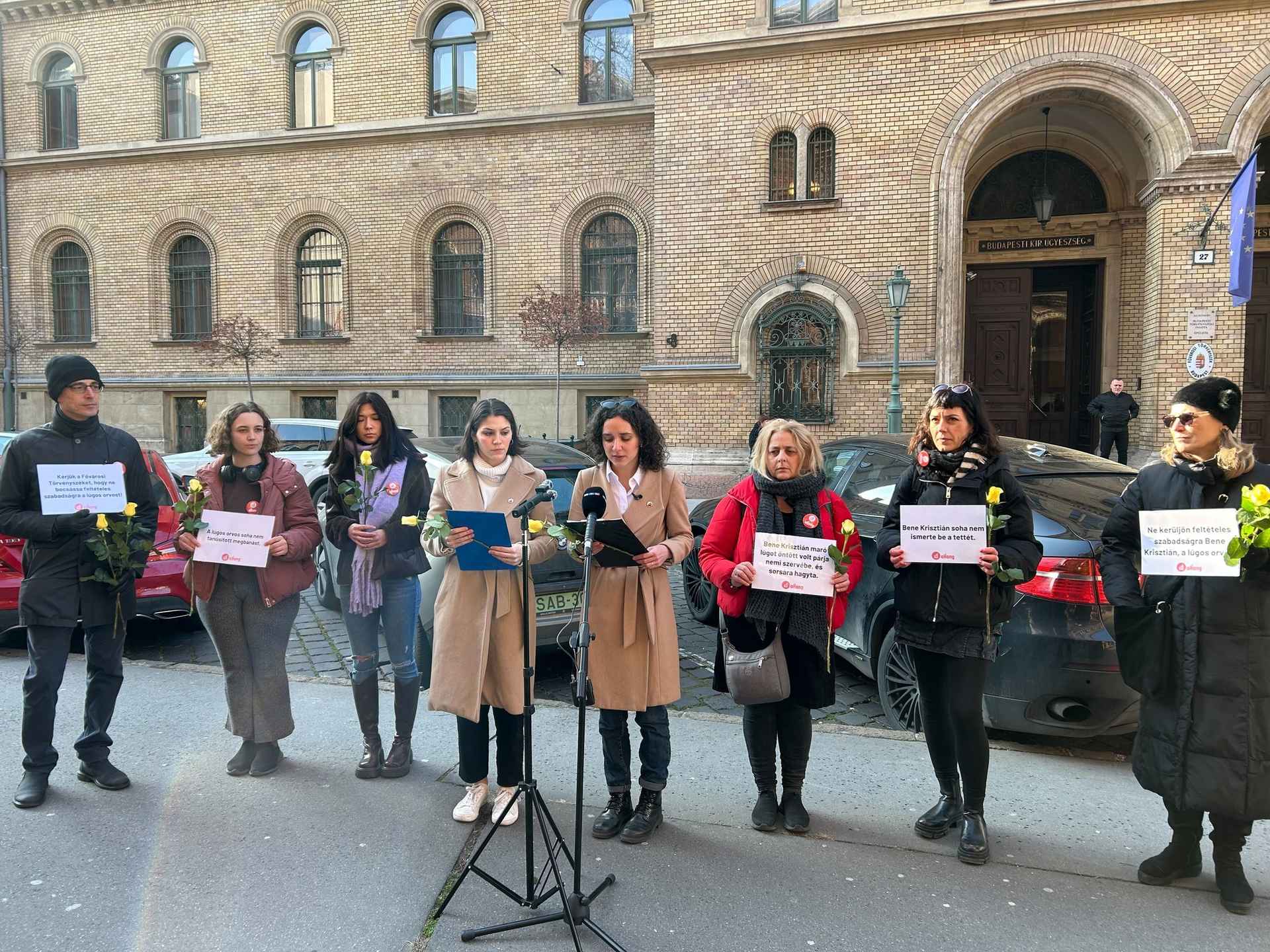
Because we knew the decision on parole could be made at any moment, we delivered the petition only six days later—already with 50,000 signatures—to the Budapest-Capital Regional Court. Despite the short timeframe, dozens of compassionate people joined the press conference accompanying the handover, to stand in solidarity and express their protest by their presence and with a single white rose. We also read out a message from Erika Renner, who thanked the aHang team and the signatories for their enormous support.
We also launched an email writing campaign addressed to Minister of Justice Bence Tuzson, calling on him to do everything possible to protect victims.
On March 17, the Budapest-Capital Regional Court announced its decision: the “alkaline doctor” would not be granted parole. We breathed a sigh of relief—we won!
And we achieved longer-term impact as well. Lawmakers went on to amend the law, introducing the institution of permanent restraining orders—something about 1,500 of us had demanded from the Minister of Justice.
The work does not stop here. Much remains to be done to guarantee the safety of victims. But with this campaign, we proved once again that protests, petitions, and our collective actions truly matter.
41.1% of Hungarian women experience physical or sexual violence, or threats from an intimate partner. Hungary ranks worst in the EU on this issue. The contrast is staggering: while the government shows no willingness to understand or change the situation, within moments tens of thousands signed my petition to stand with Erika Renner and with victims and survivors. That gives me strength. At the handover, dozens of people also came in person—their supportive presence, words of thanks, and hugs helped me see the campaign through to the end.
Enikő Tóth, Campaign Director

Mini-Dubai: Stopped
The government has backed out of the “Mini-Dubai” project planned for the Rákosrendező site and granted the capital city the right of first refusal to purchase the land.
We launched our protest petition against the project in the spring of 2024. Then, at the beginning of 2025, the number of signatures surged — nearly 30,000 people signed it in just two weeks. Such a massive protest clearly played a role in forcing the government to retreat! Alongside political and legal pressure, our mobilization became impossible to ignore.
We prevented a situation in which only a foreign state’s government would have been able to decide what happens to one of Budapest’s most important development sites.
We ran numerous ads on social media platforms, reaching hundreds of thousands of people with information about the government’s plans, organized actions, and engaged the press. For now, it seems there will be no 500-meter skyscrapers or luxury malls at Rákosrendező. But we know this government and its policies: if necessary, we will raise our voice against similar projects in the future!
Standing Up for an Independent Justice System
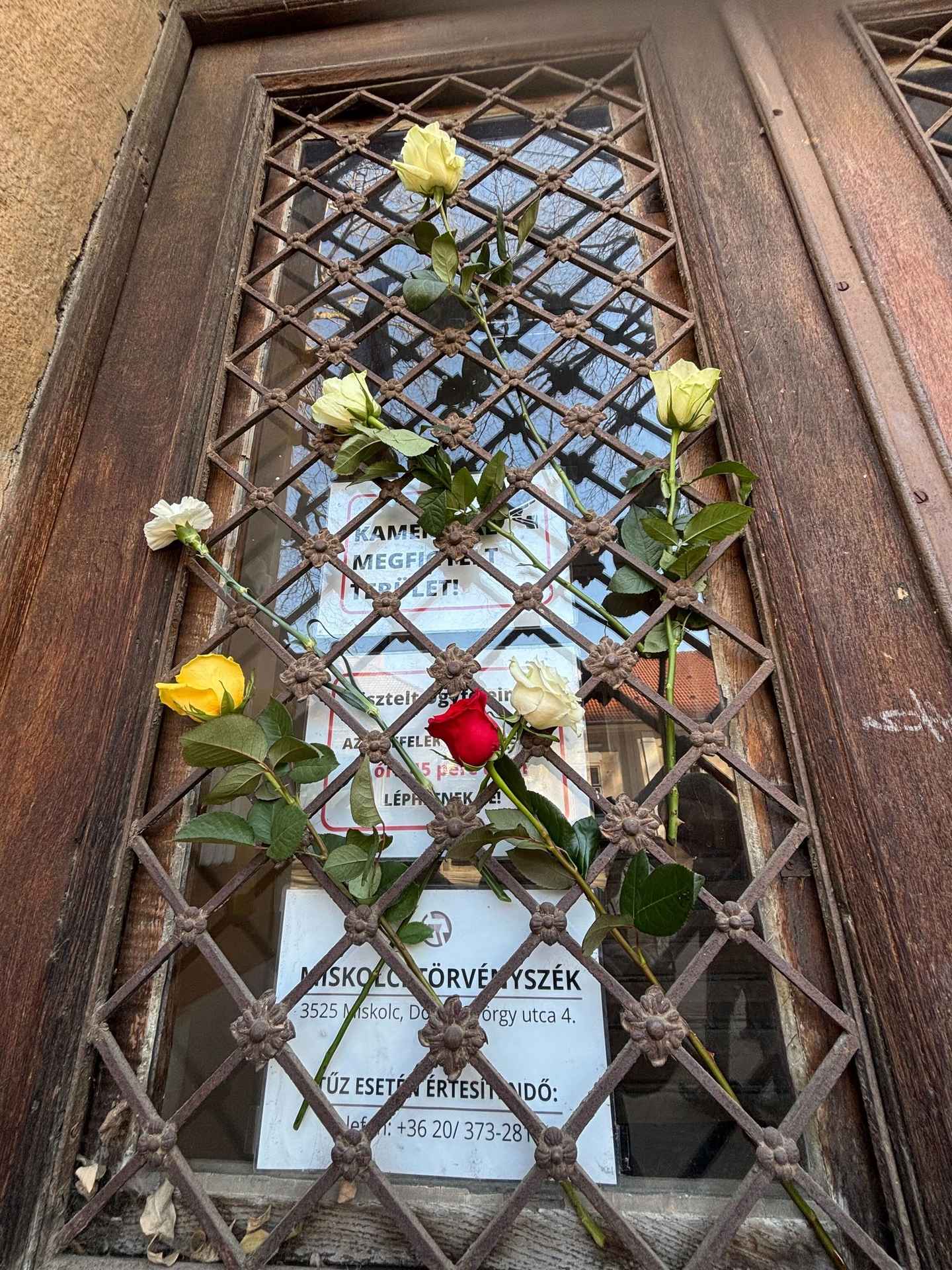
On Saturday, February 22, judges held a demonstration for their independence. We called on our supporters to take a single flower to their nearest courthouse as a sign of solidarity. From Győr to Debrecen, people across the country joined the initiative. Our local groups—the aPonts in Szeged, Nyíregyháza, Miskolc, Békéscsaba, Pásztó, Budapest, and Szolnok—organized flower deliveries, with 50–100 people participating at several locations.
These actions resulted in more than 100 media appearances. We featured on national and local TV channels, gave interviews to radio stations and newspapers, and nearly every major media outlet covered our efforts.
We are extremely proud of our nationwide aPont network!
Together for Health Workers
On March 8, the Hungarian Medical Chamber (MOK) and the Hungarian Doctors’ Trade Union organized a demonstration in Budapest’s Kossuth Square to protest the state of the healthcare system. According to MOK, Hungarians’ health deserves better, and a comprehensive reform of healthcare is needed—lives are at stake.
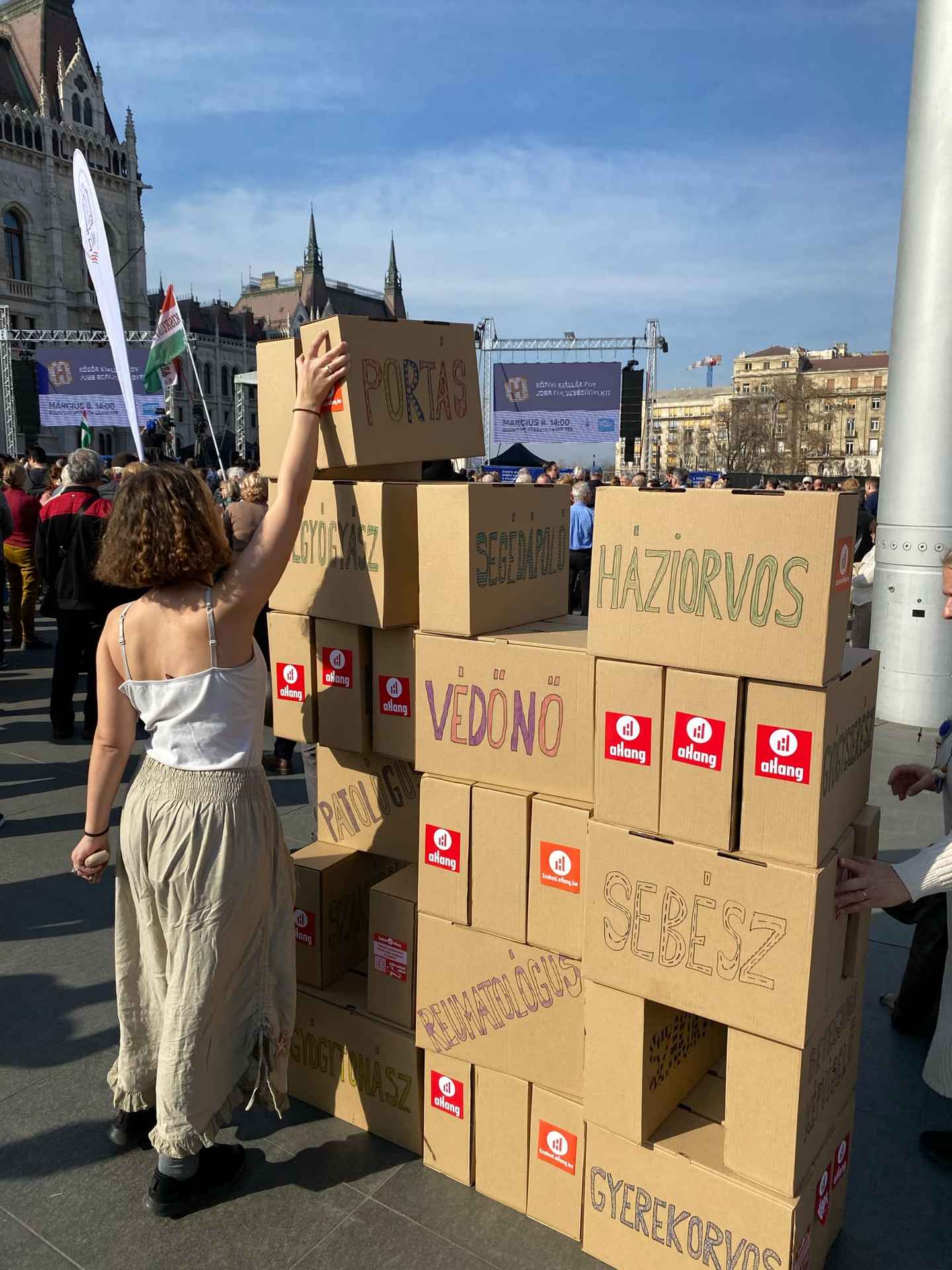
At the demonstration, aHang’s Budapest activist group—the Budapest aPont—built a giant Jenga tower. Each block was labeled with a healthcare profession, such as physiotherapist, surgeon, dietitian, or paramedic. The collapsing tower symbolized how the healthcare system is falling apart without its workers.
At the same time, aHang local groups organized parallel actions in Nyíregyháza, Orosháza, Békéscsaba, and Szeged, to demand improvements in healthcare.
In Szeged, nearly 100 people gathered in front of the old Hospital No. 1, issuing a symbolic “medical prescription” for what Hungarian healthcare needs. In Békéscsaba and Orosháza, local aPont activists stood with doctors and healthcare workers. In Orosháza, participants built a healthcare Jenga tower out of shoeboxes, while in Békéscsaba, they wrote the sector’s most pressing problems on prescription slips. In Szolnok, the local aPont placed a Jenga installation outside the Hetényi Géza Hospital.
The messages written on the blocks highlighted the system’s severe crisis: lack of professionals, outdated equipment, and the closure of essential services such as the maternity ward in Mezőtúr and pediatric cardiology in Szolnok.
No Minister Can Escape Us
A section of the M30 motorway was inaugurated in 2021, but little more than two years later such serious defects appeared that it had to be closed. We held a public forum on the restoration of the M30, which drew huge public interest— and Minister János Lázár joined us at our invitation!
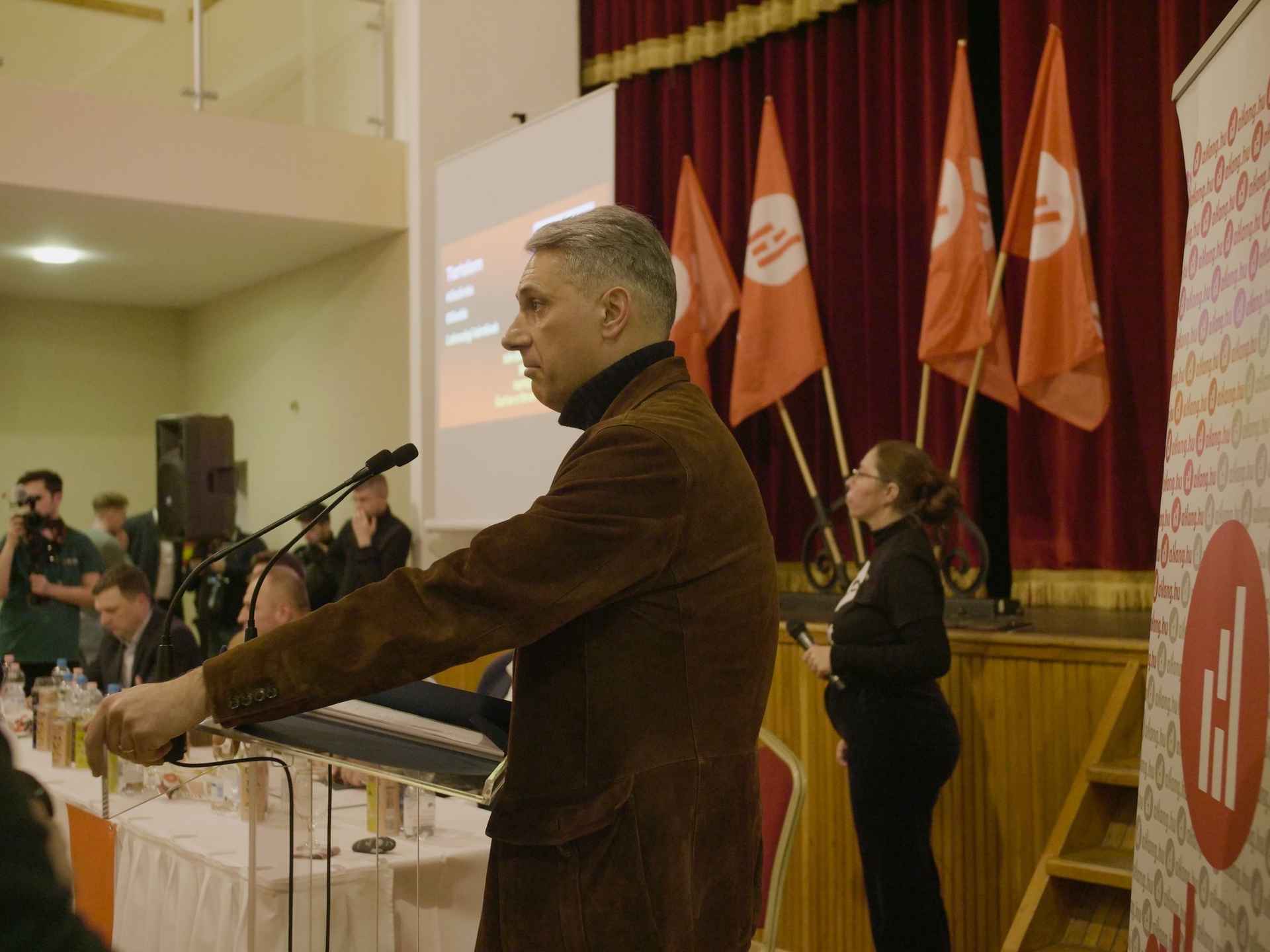
About two hundred of us gathered at the Incubator House in Szikszó, where the event began with speeches.
Among the speakers were: certified civil engineer Dániel Pach; József Pántya, Deputy State Secretary at the Ministry of Construction and Transport; Bálint Nagy, State Secretary for Transport; Lujza Sikoparija, aHang’s county coordinator for Borsod-Abaúj-Zemplén; Gábor Gyenes, leader of aHang’s local group, the Miskolc aPont; and Minister János Lázár himself.
Minister Lázár made three key promises to us:
- By October 31, 2025, the motorway will be repaired and reopened to traffic.
- At the heavily burdened Arnót Road roundabout detour, a temporary traffic engineering solution will widen the road from one to two lanes.
- Drivers who bought an annual county toll sticker but could not use the motorway will be compensated.
This is a huge achievement — as is the fact that all major media outlets reported on our public forum. Immense thanks go to our local group, the Miskolc aPont team, for achieving change with such a high-quality and successful campaign and public forum!
We Saved Kondor Béla Primary School
In March, the government decided to close down Kondor Béla Primary School in Budapest’s District XVIII Havanna housing estate. Parents and local residents began protesting, and within just a few days more than 3,000 people had signed our petition against the closure.
In recent years, we have often managed to stop changes of management or school closures together — from Szentes to Budapest, we’ve had many successes. And it never happened without visible and vocal protest.
This time too we succeeded! Collective action worked: the school was saved from closure!
The Budapest General Assembly Discussed Our Petition on Bulk Waste Collection
In December last year, we launched a petitionto preserve door-to-door bulk waste collection in Budapest. The background: MOHU, Hungary’s national waste management concession company, had published a plan to replace the system with collection points in each district.
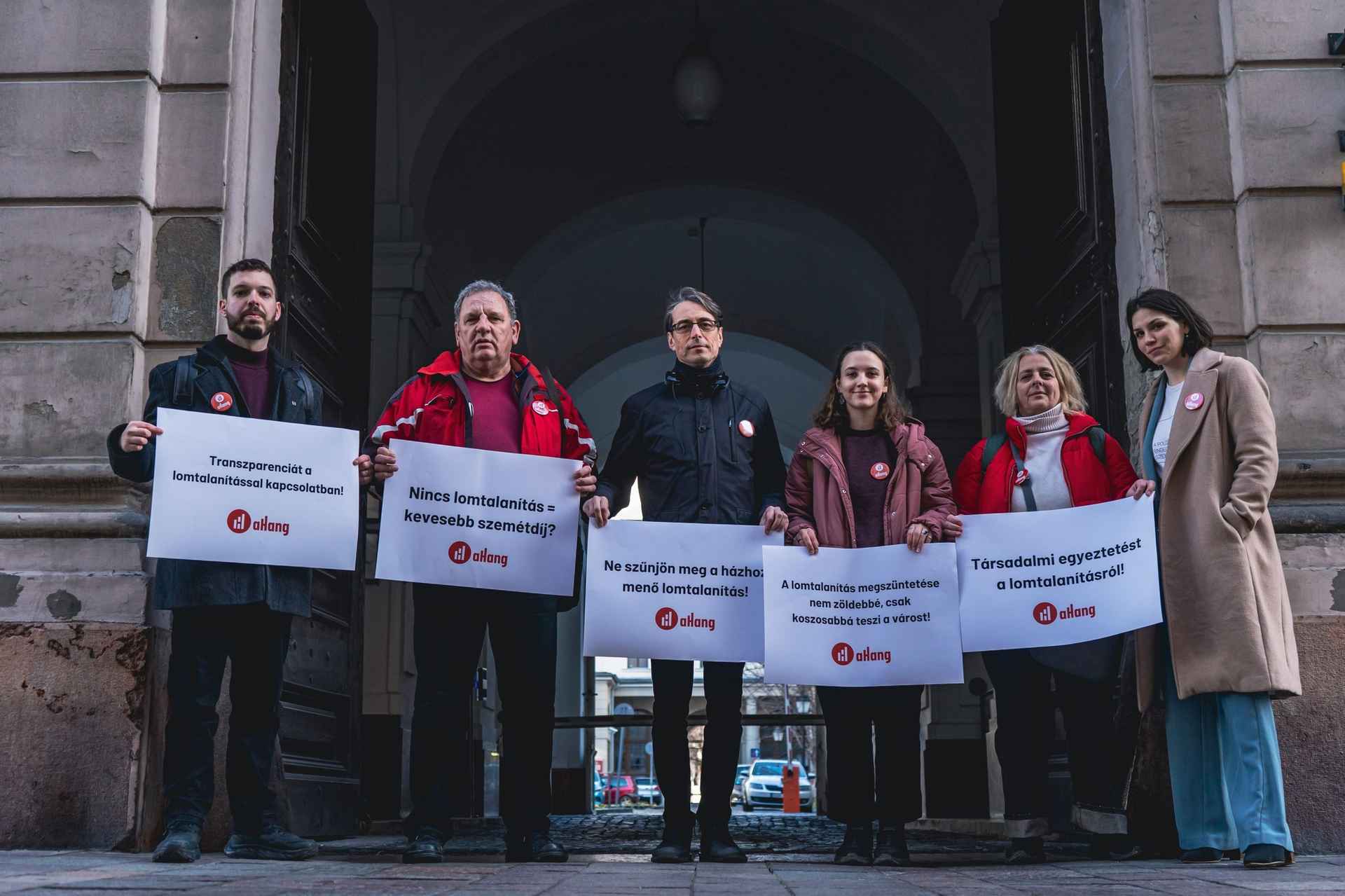
More than 8,500 people signed our petition, and nearly 2,000 of us sent emails to MOHU urging them not to change the system. The issue sparked major outrage and, thanks to our campaign, we received numerous media inquiries and were invited to the Budapest Assembly’s Committee on Climate Protection, Transport, and Urban Development to present our concerns.
At the meeting, our colleague and petition initiator Luca Soltész laid out the problems, and the committee — from Dávid Vitézy to Fidesz MPs — unanimously agreed with her. She also stressed that she hoped the coming period would be about genuine social consultation.
Because of the public backlash, we bought time: the new collection-point system will only be phased in from 2027, and only in those districts that insist on abandoning the current door-to-door system.
It was inspiring to work on an issue that affects everyone. While bulk waste collection happens just once a year, changing the system would cause serious difficulties for residents — especially the elderly, families with small children, and people with disabilities. I am glad that public outrage led to action, and I trust that MOHU will eventually abandon this unsustainable plan.
Luca Soltész, Campaign Coordinator

We Saved the Csengey Garden in Miskolc!
In February, the Csengey Garden in Miskolc — which in recent years had become a unique community and cultural space — came under threat. The city council adopted a decision allowing the garden to be built over for a new educational institution, even though several unused buildings could serve that purpose.
Our local group, the Miskolc aPont, together with partners (the civil group Desk Mates, and independent municipal representatives Tibor Szopkó and Dénes Szarka), launched a petition to save the garden, which gathered over 1,600 signatures.
The petition was delivered to the decision-makers by Lujza Sikoparija, aHang’s county coordinator in Borsod-Abaúj-Zemplén — and soon after came the news: on March 20, the Miskolc city assembly voted unanimously to preserve the garden as a community space. Our joint action succeeded, and the city leadership was forced to take residents’ will into account!
This victory is owed entirely to our supporters! Without this unity, today we would already be speaking of the Csengey Garden in the past tense.
One Step Closer to Safe Abortion in the EU
We did it! We gathered enough signatures from Hungary to support safe and accessible abortion in Europe. This is a huge success! The My Voice, My Choice European Citizens’ Initiative aims to guarantee every woman in the EU the right to safe and free abortion — even if it is illegal or barely accessible in their home country. For the European Commission to take it up, one million signatures must be collected. Every year, 39,000 women die because they lack access to safe abortion.
Many European organizations, including aHang, joined the campaign. From Hungary, 14,805 signatures were required — and we exceeded the target by over 1,000! This extraordinary result was made possible by our aPont groups’ successful street campaigning and our intensive online outreach.
Thank you, in the name of Europe’s women!
In Focus
In Focus
Naming Those Who Are Looting Our Country
On March 27, 2025, we held the first-ever National Oligarch Day in Kossuth Square. We launched this event because we felt it was finally time to call things by their name: today in Hungary, billions in public funds are siphoned into private equity funds, always ending up in the same hands — those close to the ruling party. On this day, we did not mince words. We “celebrated” those without whom perhaps this country would still be functioning.
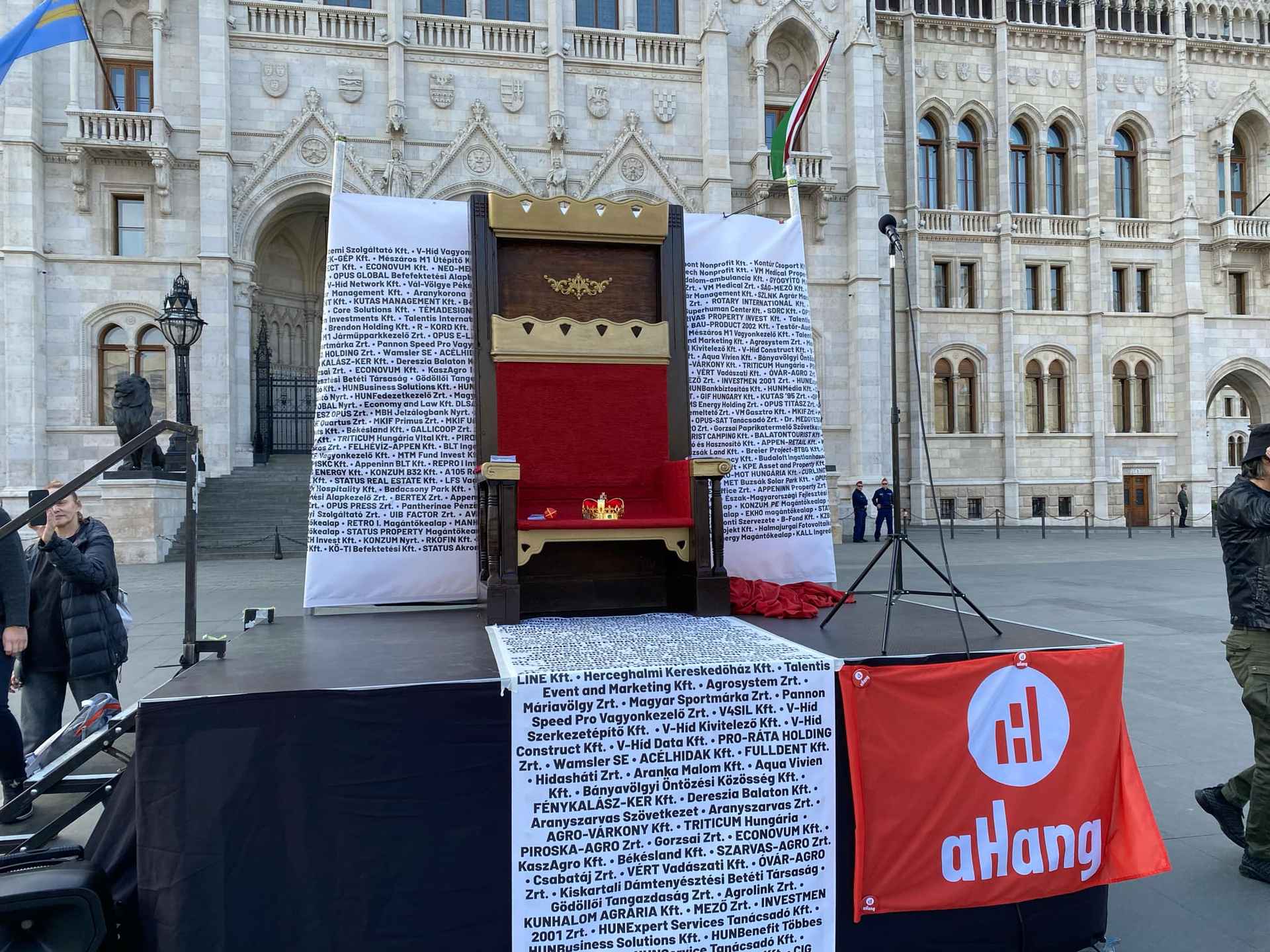
The centerpiece of the satirical yet painfully serious event was the oligarch throne, covered in red velvet. In front of it we displayed the names of companies belonging to Lőrinc Mészáros’s business empire — though the list could never be complete, as by the time the banner was printed, yet another company had entered his portfolio. Anyone could sit on the throne for a photo, but most found it unpleasant, frightening, and even painful to place themselves in such a role, even for a moment.
Visitors could also “win” a public procurement contract on a spinning wheel, where every slot but one read NER (System of National Cooperation). Through the game, we wanted to show that it’s no coincidence who ends up receiving public funds. A private equity fund was also present — in the form of a plastic box — where participants could symbolically throw in “state” forints.
At another stand, visitors could guess the fortunes of Hungary’s wealthiest businessmen — including István Tiborcz, László Szíjj, István Garancsi, and Gyula Balásy — and imagine what they would do if they could step into the shoes of “tender king” Lőrinc Mészáros for a day.
We hope that next year there will be no need to organize another National Oligarch Day. But if nothing changes, we will be back — once again naming those who really hold the reins in this country. From Békéscsaba to Veszprém, from Miskolc to Szentes, we will expose every local baron. We cannot remain silent any longer.
We also laid out a “red carpet” leading to the throne on Kossuth Square, printed with the names of companies linked to Lőrinc Mészáros. The banner stretched five meters and bore hundreds of company names. The most surreal part of the action was that by the time it arrived from the printer, news broke that yet another company — an airport — had been purchased by the Prime Minister’s childhood friend.
Viktor Szalóki, Political Director

Over the past decade, countless individuals close to Viktor Orbán have amassed fortunes in the tens or even hundreds of billions of forints. These oligarchs and front men became some of the richest people in the country through public procurement — fed by public money. This is why it is of utmost public interest that the tax authority investigate the background of their wealth accumulation.
We launched a petition demanding wealth investigations of oligarchs and their proxies. As we said at the opening of the first National Oligarch Day: these people hold the future of our country in their grip and are plundering our nation. That is precisely why we cannot stay silent about what is happening. The first step toward the dynasty’s downfall is naming those responsible.
While ordinary Hungarians fall into poverty, municipalities, hospitals, and cultural institutions teeter on the brink of collapse, and economic indicators worsen, these oligarchs have grown unimaginably rich on state money.
We demand transparency in the wealth accumulation of those who have fattened their wallets with billions in public funds — and we demand that all public assets be properly used!
Reducing Food Prices
We launched our campaign on lowering the VAT on food more than two years ago. Our goal is to reduce VAT on basic food items to 5% and lower the tax on all other foods from the EU-record 27%.
Since 2020, prices in Hungary have risen by over 58%, with food inflation surpassing 80% over the past five years. The government first introduced price caps, then margin caps, but in reality these measures hurt consumers in the long run: once lifted, prices jump
This spring we asked our subscribers through a questionnaire how they had experienced the inflationary years. We learned which products they thought were hit hardest by price hikes, and which food categories they considered most urgent for VAT reduction.
Respondents said the rising prices of vegetables, fruits, bread, and dairy were the most painful. The survey clearly showed it makes sense to continue pushing for lower VAT.
International research has repeatedly shown the effects of lowering VAT on (healthy) foods: not only do prices decrease, but consumption rises significantly, leading to healthier diets for society as a whole.
For this reason, we’ve taken to the streets several times on this issue and produced video interviews as well—asking shoppers at Budapest’s Teleki Square and Fény Street markets about their experiences. We also spoke with the team from Heti Betevő (Weekly Meal), who distribute food to people in need. Through these conversations we not only learned more about their work, but also heard about the difficulties they themselves faced during recent years of inflation. The number of people they help has steadily increased.
For all these reasons, we find it vital to continue pushing for lower VAT on food—so we can create a healthier, fairer, and more livable country.
Increasing Family Allowance
Our campaign to double and index the family allowance to inflation has been running almost as long as aHang itself. One of the very first petitions on our platform was launched in 2018 by the Chance Lab Association and the Dignified Livelihood Working Group and has since been joined by more than 70,000 people. It is more relevant than ever today: the base amount of the family allowance has remained unchanged since 2008—12,200 forints.
Highlights of the campaign:
In 2020, the Chance Lab Association sent an open letter to decision-makers demanding that the family allowance be doubled. They emphasized that it is crucial for protecting families and preventing child poverty. Thirty organizations joined the letter as co-signers, showing the weight of the issue.
Also in 2020, Katalin Novák was appointed Minister without Portfolio for Families. More than 4,000 of us sent emails to her, as well as to State Secretary for Social Affairs Attila Fülöp and Deputy State Secretary for Family Policy Attila Beneda, urging them to double the allowance—especially urgent during the COVID-19 crisis. We received no substantive reply.
Public opinion polls regularly include the question of raising the family allowance, and the vast majority always support it. Yet despite this broad support, decision-makers continue to sweep the demand off the table. They point to other family support schemes, such as tax breaks, income tax exemptions, or the CSOK housing program—but the problem is precisely that these do not reach everyone. By contrast, the family allowance is universal, supporting every family with children, including the most vulnerable: large families, single parents, families with disabled children, and those in poorer financial situations.
In 2021, we surveyed parents who had signed our petition, asking whether they were eligible for the government’s family support measures at the time—such as subsidies for large families to buy cars, baby bonds, tax exemption for mothers of four, CSOK and CSOK-loans, and home renovation grants. The results: most were not eligible; or if they were, they either could not or did not want to use them. While our survey was not representative, the findings were still thought-provoking.
In August 2024, Zsófia Koncz was appointed State Secretary for Families, taking over the position once held by Katalin Novák. More than 2,000 of us sent her emails, with the following questions: What does she think of the current level of the family allowance and of raising it? What plans does the government have for it? Why, despite introducing new forms of support in recent years, has the government not touched the allowance since 2008?
We even attempted to meet her in person: one morning we waited for two hours in front of her workplace, but she never arrived. We only wanted to ask her two questions: why do only high-earning families benefit from the major support schemes, and does she care enough about families to stand for doubling and indexing the family allowance to inflation? Although we did not meet her, we handed out flyers to ministry staff going into the building, asking them to deliver them to her office (thanks to inside sources we even had the exact office number).
To this day we have received no substantive answers from the State Secretary.
The highlight of our campaign was planned for May–June 2025: we intended to increase pressure on MPs by handing over the petition to many of them in person, while organizing further actions until we received answers. However, these plans were swept aside by the fight against the silencing bill. But we will not give up. We firmly believe that supporting economically vulnerable families is critical. That is why in July we will hand over the petition to Fidesz MPs and continue the campaign to double and index the family allowance to inflation.
Period Poverty
Today in Hungary, tens of thousands of women and girls miss school, work, or social life simply because they cannot afford basic hygiene products. Period poverty is real. And while it is rarely discussed, its consequences are severe.
Research shows that one in ten women—and in disadvantaged areas even one in three or four girls—lack adequate access to pads or other menstrual products. This is not just an inconvenience: it is humiliation, exclusion, and a question of equal opportunity. Girls who miss school receive worse grades and have a harder time finding jobs later. For adult women, it can mean job loss and isolation.
That is why we launched a petition —already signed by more than 10,000 people—calling on local municipalities to provide free menstrual pads to women and girls in need.
There are already good examples in Hungary: in Budapest’s 8th and 9th Districts, pads are available free from vending machines; in the 2nd District, “menstruation-friendly” bathrooms have been set up. Some clinics, schools, and even cafés have also implemented measures. But this is still far from enough. Every community needs solutions like these—including those that currently provide no support at all.
To raise awareness, we produced a videowith local elected members, and we held street campaigns in cities nationwide to reach as many people as possible. The responses were clear: people understand why this matters, and many are personally affected.
Menstruation is not a luxury. It is not a privilege. With our petition we demand that every municipality take responsibility and ensure that no woman has to miss school, work, or even going outside—simply because she cannot afford pads. We will continue our campaign, and this autumn we will deliver the petition in person in numerous towns and cities. We will not stop!
aPont Overview
aPont Overview
Borsod-Abaúj-Zemplén County
aPont Miskolc had a busy half-year, marked by numerous successful campaigns and actions. In January, the group continued its intensive campaign on the M30 motorway, which had begun the previous year. This was essential, as a motorway built with more than 200 billion forints became unusable when a section had to be closed due to road defects, impacting a large portion of the county’s population. Following several roadside demonstrations, the group organized a public forum attended by Minister of Construction and Transport János Lázár, along with other officials and independent experts. At the forum, aPont Miskolc not only pressed the minister and the ministry for answers, but also presented a comprehensive package of proposals. Their demands included measures for traffic calming, compensation for drivers, and reconstruction of the motorway. The activists can be proud of the results achieved: the Arnót roundabout was expanded, ending traffic jams; volunteers were invited to monitor the reconstruction milestones as members of a ministerial working group; and most importantly, in 2026 local motorway users will receive significant discounts as compensation.
In March, aPont Miskolc learned that the Csengey Garden, one of the city’s most popular cultural spaces and the last major undeveloped downtown lot, was under threat. The newly elected Fidesz-led city government planned a completely unnecessary 4 billion forint development there. The group quickly launched a petition to save the garden, which gathered over 1,600 signatures within days. The twist in the story is that the local Fidesz–KDNP municipal caucus first voted unanimously in favor of the development — but after our petition, the very same caucus unanimously rejected it.. Activist work on the ground is vital. Sometimes confrontational tools are necessary, but at times it is just as important to celebrate—and this time there was something to celebrate. Together with local residents, the activists organized a festive jazz concert. People showed their gratitude by bringing lots of cakes, while aPont Miskolc presented an overview of their work so far.
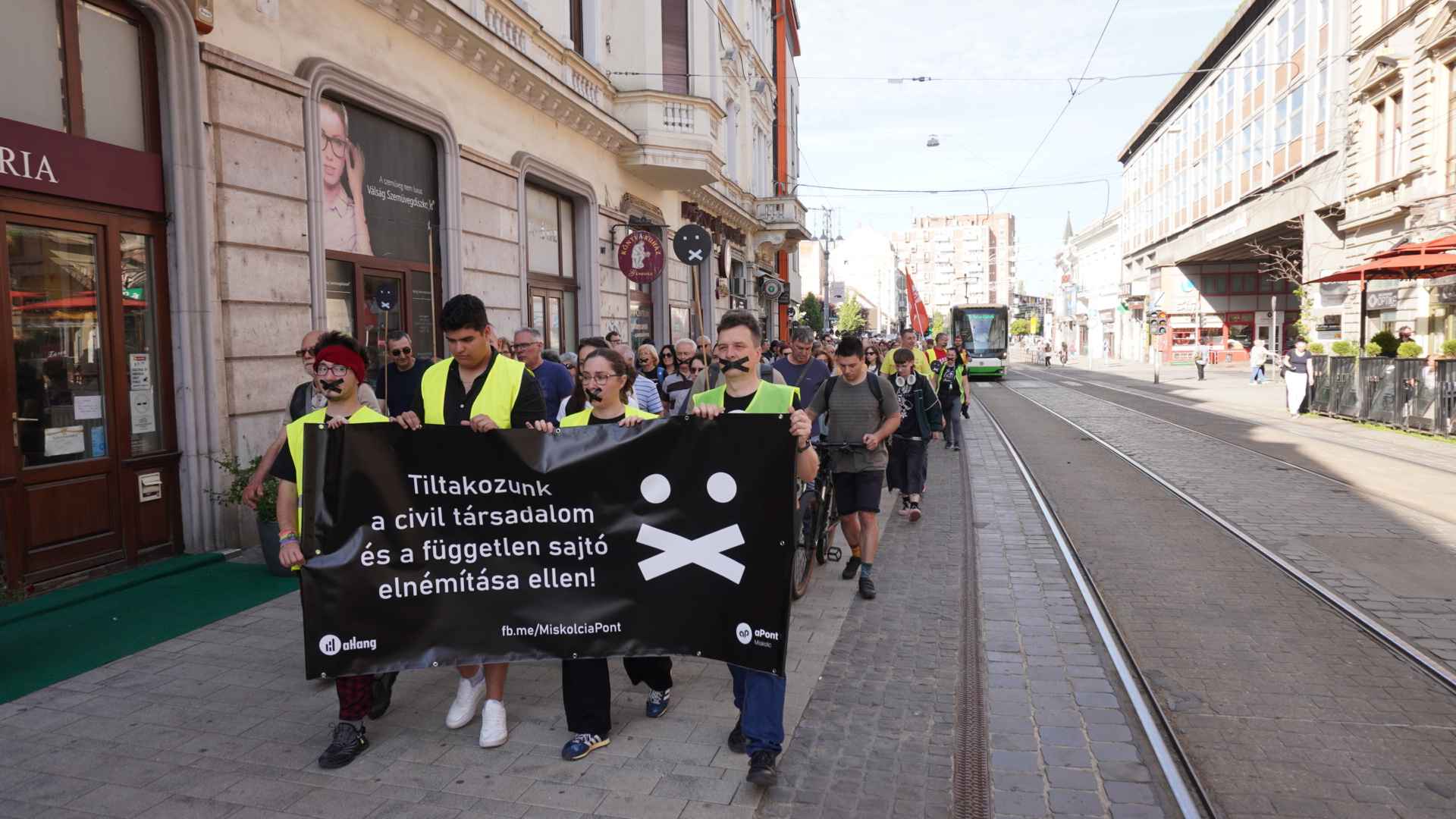
In April, responding to public demand, aHang’s Miskolc group organized a protest against the curtailment of the right to assembly. More than 300 people joined to express their commitment to freedom and democratic rights, and many signaled their intention to join the local team.
In May, the news of the nationwide “silencing bill” naturally reached the community of aPont Miskolc as well. Activists helped organize the wave of protests in the county, holding demonstrations in Miskolc, Tiszaújváros, and Kazincbarcika—mobilizing around 1,000 people in total. Residents in all three towns showed that collective resistance can be organized locally too, and that people are ready to face government threats with courage.
Although Fidesz was eventually forced to retreat, the local group did not rest. When a local resident launched a petition against closing the high-quality medical unit at the Ellipsum spa, aPont Miskolc joined forces and in June organized a demonstration in Miskolctapolca. The handover of the petition will follow soon.
From the beginning, we set ourselves the goal of creating a rapid-response local group capable of representing both local and national issues. We are proud that in recent months we have lived up to this commitment. Our Borsod-Abaúj-Zemplén team is a creative, brave, and resilient community that can truly be counted on. The greatest recognition for us is that local people now know us, turn to us with trust, and believe in us—just as we believe in our city, our county, and ourselves.
Lujza Sikoparija, aHang County Coordinator for Borsod-Abaúj-Zemplén

Békés County
In the first half of the year, the Békés county group focused on two directions: taking part in nationally significant actions in coordination with other counties, and addressing key local issues. Among the former were placing flowers at courthouses in solidarity with judges and judicial independence, and building a precarious “tower” out of shoeboxes to highlight the crisis in healthcare and the need for quality services.
Two major issues arose in the county during this period. The first was healthcare-related: the Orosháza hospital suspended inpatient cardiology care, and weekend and holiday emergency care was not available. The local aPont launched a petitiondemanding improvements. The issue also reached the national sectoral policy agenda: State Secretary for Health Péter Takács visited the site, although he ultimately did not meet the participants of the demonstration announced for the same time.
The second issue was shale gas extraction in the Sarkad Basin. The environmental and long-term effects are severe, and with expansion plans in the news, the problem could soon directly affect many more residents. aPont Békéscsaba consulted locals, contacted expert partners, and is working on a broad campaign of information and mobilization. While the lack of concrete information has made local mobilization more difficult, national green organizations are engaged, and our local group considers building local connection points a key task.
Other local campaigns were also launched: petitions for the long-promised renovation of Gyula’s railway station, and for a firework-free Békéscsaba is.
The series of actions against the “public transparency” bill gave huge momentum to both volunteers and supporters. In Békés, demonstrations were successfully organized in Békéscsaba, Orosháza, and Gyula—bigger and more visible than before. The nationwide wave of protests by aHang’s local groups showed the strength of local activism and inspired people in Békés to recognize their own power.
aPont Békéscsaba also launched an online public discussion series, Csabai Hangadó (Csaba Voice). Topics include education, media, communities, nature and environmental protection, organizing, and social research. The first guest was MP Ákos Hadházy.
The growing public interest has sharpened my focus on county organizing while also increasing the responsibility we feel. The early stages of campaigning in the county are already creating a basis for future mobilization by connecting people and informing them about local issues. The professional community among coordinators has become increasingly important to me—not only for operational support, but as a circle of shared ideas, encouragement, and reassurance. There is growing attention and curiosity about the knowledge and potential within our teams. We continue forward with strong confidence.
Ildikó Fazekas, aHang County Coordinator for Békés

Csongrád-Csanád County
In the first half of 2025, aPont groups in Csongrád County focused on water resources, solidarity actions, support for healthcare, and resistance to the government’s attempts to undermine civil society.
The aPont group in Szeged worked to improve the reconstruction plans of a railway crossing that has made everyday life difficult for local residents. They also held film clubs and discussion events, and took part in national solidarity actions such as demonstrations for judicial independence and healthcare. At every action, the aim was to ensure active participation by those involved.
Water management in the Homokhátság region became a key issue of interest, with several events on water poverty and access to clean drinking water. During Water Week, the local group organized multiple programs. Building on this, their next major campaign targeted arsenic removal from drinking water in Makó and surrounding towns. Activists held street outreach in many places, organized a public forum in Makó, and submitted freedom of information requests.
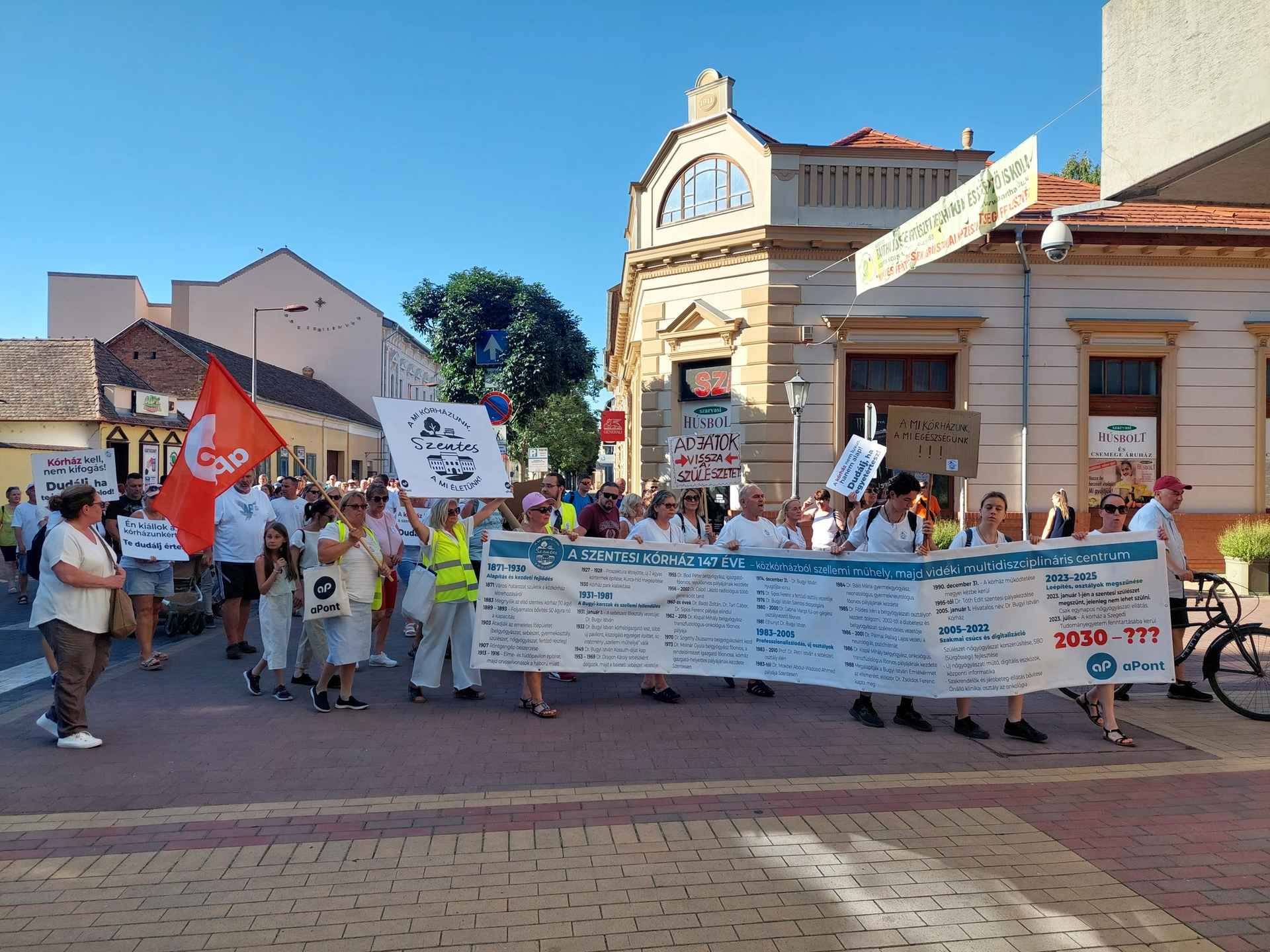
In Szentes, activists campaigned on the uncertain future of the local hospital, pressing its operator to inform residents about what to expect as the institution visibly declined. On July 1, National Healthcare Day, the local aPont held a silent march: more than 200 people walked from the hospital to Kossuth Square.
Regarding the silencing bill, aPont groups held protests in front of Fidesz offices in four major towns in the county. At each location, turnout was strong and determination was evident—contributing to the success of the nationwide resistance.
I am glad to see the growing visibility of the aPonts, with more and more people reaching out to us with their own issues. Local activism is spreading beyond Szeged to Makó and Szentes as well. I love seeing how each community has its own spirit, and how people discover their power to influence the issues that affect them.
Rebeka Tóth, aHang County Coordinator for Csongrád-Csanád

Budapest
The Budapest aPont was established in December 2024, with partly different tasks from other aPonts: in addition to local issues, it also supports the central team’s actions. Budapest activists were present at the City Hall protest against ending door-to-door bulk waste collection; at the Budapest-Capital Regional Court for the handover of the petition against parole for the “alkaline doctor”; and at Kossuth Square during aHang’s first National Oligarch Day.
They also joined nationwide aHang actions: placing flowers at courthouses in support of the Hungarian Association of Judges, and building a giant Jenga tower at the Hungarian Medical Chamber’s healthcare demonstration on Kossuth Square to symbolize the fragile state of the system. Their biggest action was taking part in the silent march against the silencing bill, where thousands walked in silence across Liberty Bridge. The Budapest aPont also joined the joint action with aHang and other civil organizations at the Castle Tunnel, unfurling massive banners with the civil heart symbol and the slogan: “We were created for you. We are with you. We remain because of you.”
The group has also taken up its own local issues, such as protesting the fencing off of Fisherman’s Bastion, campaigning for public toilets in Józsefváros, for Kiss & Ride parking, and against ill-conceived school reorganizations in outer Pest. Their campaign against plans to place a cross on the Liberty Statue received the most media coverage. As part of this, they organized a torchlight march for freedom on Gellért Hill, and launched the “Solidarity Statues” movement, in which activists placed symbolic crosses on more than 50 public statues.
The main lesson of this half year: with more people, we can carry heavier loads and achieve much more together. The Budapest aPont is a great team of dedicated and creative people. It is inspiring to see everyone gradually finding their place and contributing in ways that suit them. I am especially proud that in April the unofficial zPont was formed: a group of mostly twenty-something activists from several counties, who now meet weekly to share updates and lend their skills in areas like design and social media to support aPonts nationwide. They were the ones who pushed for our presence at the Bánkitó Festival and at Pride.
Eszter Békefi, aHang Budapest Coordinator

Jász-Nagykun-Szolnok County
The year 2025 began in Jász-Nagykun-Szolnok with a petition to reinstate the maternity ward in Mezőtúr. The collective effort brought quick results: the ward temporarily reopened—only to be closed again. The campaign therefore continues. Meanwhile in Szolnok, a team of future aPont volunteers came together. On the day of the judges’ demonstration, they placed flowers at the courthouse entrance in support of judicial independence.
In March, Szolnok aPont activists also joined the Hungarian Medical Chamber’s protest. In a flash mob outside Hetényi Géza Hospital, they used a giant Jenga tower to symbolize the collapsing Hungarian healthcare system. The action drew attention to the Mezőtúr maternity campaign and to broader issues like staff shortages, outdated equipment, and underfunding, all of which also affect the county.
Only days later came news of a massive Chinese battery industry project planned for Szolnok. Despite this being a huge challenge for a small group of volunteers, they drafted a petitionagainst the electrolyte plant almost immediately. Very soon they organized street outreach at city council meetings, public forums, markets, the flea market, and on the streets—collecting signatures against the battery project in rain, wind, and blazing sun.
They also launched a direct email writing campaign targeting the company behind the project, and by the end of June organized a demonstration around the handover of the petition, where Akárteis (It Could Be You) and Greenpeace also spoke.
The number of signatures is approaching 7,000—a figure that has clearly crossed the threshold of political attention. The Szolnok aPont received serious promises from the mayor to block the electrolyte plant project and call a local referendum.
Even in the midst of this large-scale struggle, the activists found time and energy to campaign against period poverty, for food VAT reduction, and for doubling the family allowance. They also took part in the first National Oligarch Day. At the end of May, the local group joined aHang’s nationwide series of demonstrations: together with 16 other cities, Szolnok aPont organized a protest against the silencing bill. The proposal was eventually dropped—an achievement won by the power of collective action, as the whole country stood up for a free press and civil society.
One hundred days—that is roughly the time between the first group meeting of Szolnok aPont and the organization of the petition handover and demonstration against the electrolyte plant. Activists conducted the action in the blazing sun, dressed head to toe in hazmat suits—because they believe unwaveringly in their cause and in the power of community. I am deeply proud to be part of such a motivated and united group!
Ágnes Tollas, aHang County Coordinator for Jász-Nagykun-Szolnok

Nógrád County
The communities in Pásztó and Salgótarján were also active in public life. In Pásztó, aPont launched a monthly program series, alternating between political discussions and lighter community-building events, to engage and involve as many locals as possible. One highlight was a thematic city walk, where participants visited both problem areas and success stories in Pásztó. Afterwards, they voted on their experiences, and the group sent a letter to the municipality with proposals for improvements. As a result, several new pedestrian crossings were built—a tangible outcome of community participation.
In Salgótarján, a large-scale campaign was launched for a direct Salgótarján–Budapest railway line. The aim was to show how transport isolation severely hampers the region’s development, labor retention, and economic prospects. Activists collected about 2,000 signatures in the town’s squares and market, and in late June held a public forum where experts and residents discussed the railway’s importance. The event was streamed online to reach more people and attract new activists.
In both towns, the local aPonts also organized protests against the silencing bill, which would have curtailed civic oversight and participation. It was uplifting to see dozens of people in Nógrád stand up against the proposal. The work came with challenges—such as keeping interest alive and coping with scarce resources—but the power of collective action and the concrete results show that local action truly matters.
For me, the defining moment of this half-year was the railway forum in Salgótarján. Sitting there in the same room—elderly and young people, professionals and locals—and discussing how to reconnect Salgótarján to the country’s lifeblood, it became clear and palpable that we are not alone in feeling that change is needed. It was an honest and vibrant event that reinforced my belief that it is worth fighting—not only for the railway, but also against resignation to helplessness.
Tibor Köcse, aHang County Coordinator for Nógrád

Szabolcs-Szatmár-Bereg County
The first half of 2025 was full of planning and action for the activists of Nyíregyháza aPont and the emerging Záhony aPont.
In January, activists in Nyíregyháza identified their top priority issue, but struggled to find a supporter base around it—especially as local developments shifted attention elsewhere. The partial closure of the pediatric surgery ward in the county hospital concerned residents far more, so that became the subject of their first petition of the year. This also offered a chance to highlight the lack of information about local battery manufacturing plants.
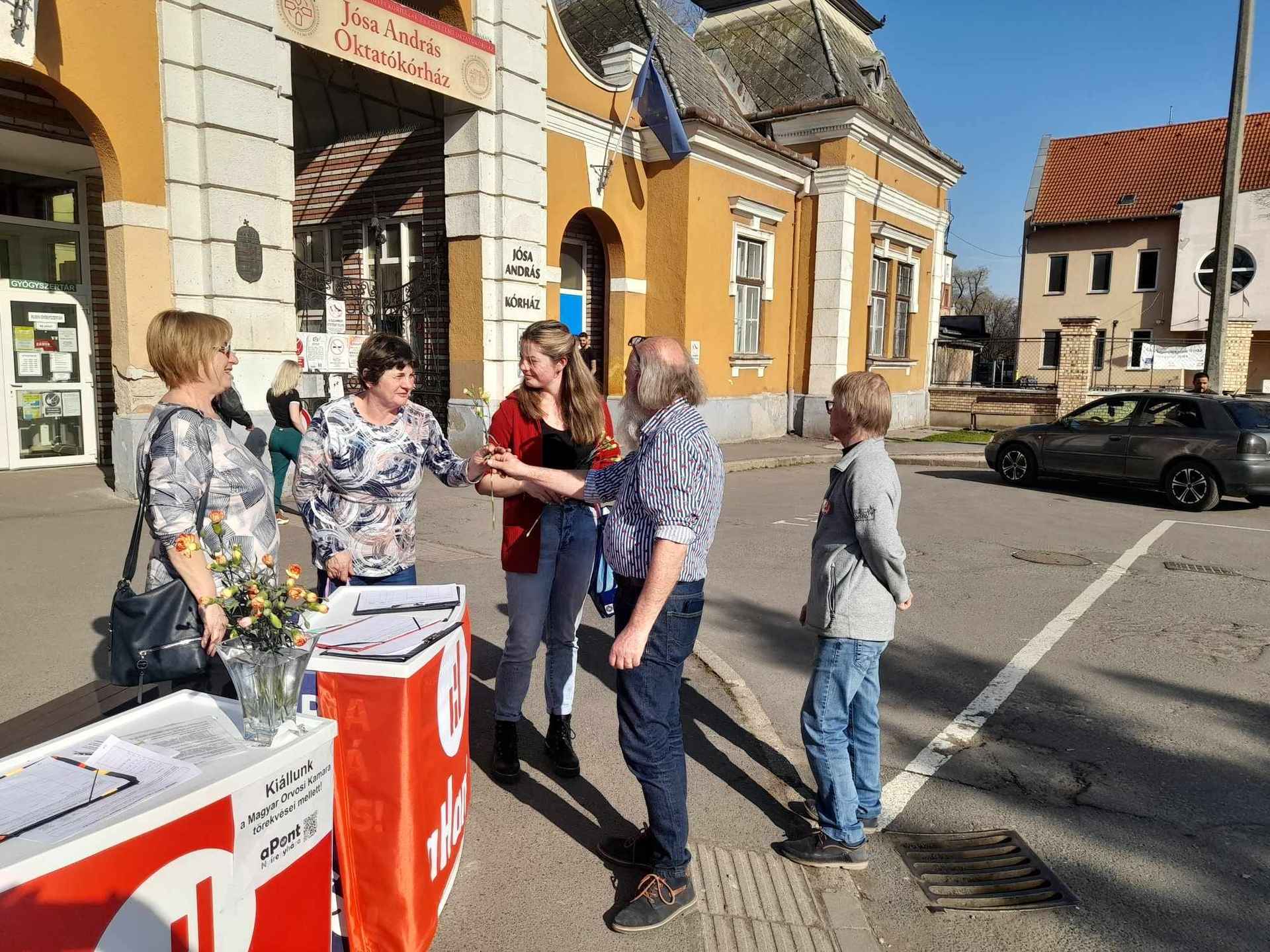
Since March, our activists have been steadily uncovering the secrecy surrounding the planned factories. At the same time, they have held ongoing street outreach for the full reinstatement of pediatric surgery services, for an online platform providing transparent information on battery production facilities, and in connection with national campaigns, such as the fight against period poverty and resistance to the “transparency” bill.
In February, Záhony became active too, as a local aPont team began forming—so the county now has two active groups. Both Nyíregyháza and Záhony activists regularly participate in demonstrations in Budapest, Miskolc, and Debrecen. Each group has also organized its own independent actions: Nyíregyháza against the “transparency” bill, Záhony in support of judges.
Both county groups have also handed over petitions. The Nyíregyháza group delivered their pediatric surgery petition to the hospital director and the mayor. Activists in Záhony twice handed petitions directly to Minister János Lázár at street forums, calling for low-floor trains on the Nyíregyháza–Záhony railway line.
We lost one of our fellow activists with tragic suddenness, and it left a deep mark on me — I was personally very moved by it (more than I would ever have expected). It was uplifting, however, to see the compassion of the activists and the way they did everything to give Józsi a dignified farewell.
Zsolt Jakab, aHang County Coordinator for Szabolcs-Szatmár-Bereg

Veszprém County
In Veszprém, our organizing only began in March, yet several actions and events have already sparked collective thinking and action.
Local volunteers joined multiple nationwide campaigns and made them visible in their own community. For the campaign to double the family allowance, they set up outreach stands around the city, engaging passersby in conversations. They also joined the wave of protests against the silencing bill: about 400 people attended the Veszprém demonstration, showing the local demand for unity. During the event, the group called on residents to remind their MPs of the oath they took upon election—to represent the interests of their constituents.
After a pollution incident in Balatonfűzfő, support for the related petition poured in from across the county. Signatories demanded accountability from those responsible, transparent communication with residents, and guarantees to prevent such incidents from happening again.
Most recently, activists focused on the Veszprém–Budapest railway line, where trains lacked air-conditioned carriages. Thanks to their efforts, changes were achieved.
The Veszprém community is only just taking shape, but the momentum and commitment are already clear. Even these first steps highlight the need for local organizing that responds to community issues. One of the goals for the next half year is to build on these foundations, strengthen the group, and deepen its social roots locally.
For me, the most powerful experience of this period has been seeing how well this new team works together. Everyone instinctively finds their own strengths and contributions, and tasks fall into place naturally without long discussions or assigned roles. This has made the joint work energetic and effective. There is great strength in how quickly this harmony has developed.
Fanni Havay, aHang County Coordinator for Veszprém

Closing Words
Closing Words
There are not two Hungarys. No matter how hard those in power try to build parallel realities, or how relentlessly they attack every critical voice that dares to disagree with them, we will not back down. Our work and our responsibility are here, and we are not going anywhere.
We are preparing for difficult months ahead: a “hot” autumn is coming, with every side ramping up their campaigns. It has often been said that we should expect the dirtiest campaign in history—and it will almost certainly be so. The coming half-year will be difficult not only because propaganda will be pouring from every tap, but also because it will be hard to hold on to our clear judgment.
What is aHang’s task and responsibility? To point to those who are responsible. Those who are accountable for the looting of the country. Those who voted for laws that trample on our freedom. Those who, abusing their power, take away opportunities from the most vulnerable.
As one of Hungary’s largest civil society organizations dealing with public life and politics, we bear a special responsibility: to be present not only in Budapest but in every corner of the country, and to tell people about the wrongdoings of those in power.
A person who is afraid is capable of terrible things. The government is now afraid. They are scared, and they will do anything to save their own power. In May we said: without an independent, free civil society, the last bastion of democracy will also fall. By autumn, this stake will grow even greater. That is why we need every bit of help, every supporter, and every person willing to take action.
Tough days lie ahead until next April. But we’re ready — because the strength and community behind aHang is something few can count on. We promise to use this support responsibly, but also boldly and visibly — just like we always do.
Support our work!
Join us!
Join us!
More and more of us are standing up for change. In the past six months, more than 130 petitions have been launched on our site. Visit our platform, SzabadaHang, explore the campaigns, and join the signatories!
Want to be even more active? Join aHang’s local activist groups, the aPonts. Our network has achieved many successes in recent years, but we are not stopping—we continue to grow, building new groups in more counties.