
Winds of Change
2025/2.
Introduction
At a Crossroads
When, after a long and relentless heatwave, the air slowly begins to stir and the first breezes give way to real gusts of wind, it feels much like seeing the record-breaking, nearly half-million-strong celebratory crowd that filled the streets for the banned Pride march. The message was unmistakable: something had shifted, and it was no longer afraid to show itself.
Immediately before the march, we were in Austria learning and working with our international partners. Our main focus, of course, was already on preparing for the elections and on the mental, physical and infrastructural step change this would require.
In fact, by then we had already spent months going through several rounds of planning so that we could enter this crucial period with a mature and well-prepared strategy. We had defined our flagship campaigns, drawn up detailed plans for building our most important election-related issues, and begun implementing the program.
Last summer we also made another far-reaching decision - one that changed the structure and operation of our entire organization. We decided to double the number of our local groups, the aPoints, so that in the coming period we would be present not only online, but physically as well, across much of the country. We recruited and contracted county coordinators, strengthened the central team, and began preparing work in the new locations. By the end of the year, we had activist groups in 12 counties and in Budapest; in several counties, more than one aPoint was already operating, with national visibility, successful campaigns and steadily growing popularity.
This report is partly about these successes and our local and national campaigns, and partly about the election-focused campaigns we spent long months developing at the planning table.
The creation of the National Wall of Shame was also the result of such a process. We conducted surveys, consulted our membership, and carried out extensive research so that we could bring together on one page — on one wall of shame — the corrupt politicians and oligarchs most responsible for the country's dire condition, and show the crimes and systemic fraud linked to their actions. Hundreds of thousands of people visited lopnak.hu already during its launch phase, and since then it has continued to form the backbone of our local and national campaign work and actions.
It is also worth mentioning here our campaign calling on the Organization for Security and Co-operation in Europe (OSCE) to launch a full-scale election observation mission. This victory is a striking example of the power of a well-built and timely campaign: in a short period of time, we were able to build broad support around the issue, shape press coverage and public debate for weeks, and ultimately hand over our petition at the highest international forum through a sharply focused and widely discussed speech. The OSCE made a positive decision, and we are very glad to have taken an important step toward cleaner elections.
In the final days of the year, we were once again back at the planning table, making the most important decisions for the election period. We analyzed possible election scenarios and refined our strategies accordingly.
It will be worth keeping an eye on us over the next six months too!
Máté Varga,
Executive Director of aHang
As the Elections Approach
As the Elections Approach
20 Years Without a Prime Ministerial Candidate Debate
It would be hard to find another self-described democracy where no prime ministerial candidate debate has been held in 20 years. Yet that is exactly the situation in Hungary. Viktor Orbán last agreed to sit down for a debate in April 2006; since then, he has backed away again and again, citing various flimsy excuses.
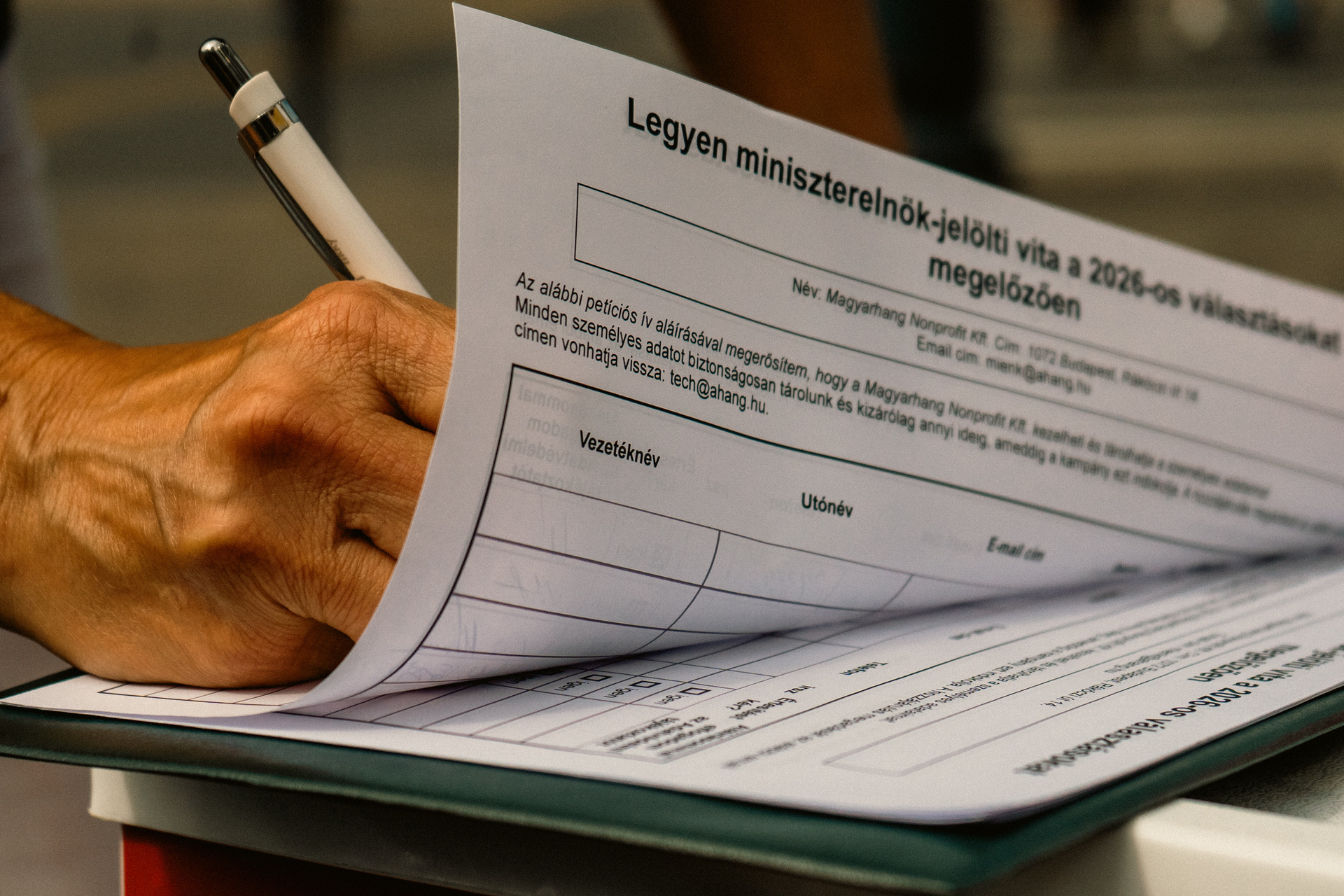
This is familiar ground for us. Since aHang was founded, at every election we have fought for Viktor Orbán to take responsibility and agree to a public prime ministerial candidate debate. We did the same this time. On 15 September 2025, the International Day of Democracy, we launched our campaign for a public prime ministerial candidate debate between the leaders of the two strongest political parties, Viktor Orbán and Péter Magyar. We did this because we believe voters deserve to hear the views of the two strongest party leaders on the present and future of the country not through propaganda and empty political point-scoring, but face to face.
On September 15, we took to the streets at more than a dozen locations across the country, setting up campaign stands and collecting signatures. Support came in at an enormous pace: already on the first day, tens of thousands of people joined our petition.
At the same time, we commissioned an opinion poll for the first time, asking whether people in Hungary wanted a public debate between the two figures. The research showed that 56% of Hungarian society as a whole wanted a debate - and that even one in three Fidesz voters expected Orbán to finally stand up and debate.
We did not stop in October: we continued our campaign and commissioned another opinion poll. On the one hand, we wanted to see how demand for a debate had changed in the month since our campaign launched; on the other, we wanted to find out what people saw as the most important topics for a prime ministerial candidate debate. The results spoke for themselves. One month after our campaign began, demand for a debate had risen by 7 percentage points across society: this time, 63% of people in Hungary expected Orbán to finally stand up and debate. It also became clear that the three topics considered most important for such a debate would be healthcare, corruption and the economy.
November marked another turning point in the campaign. Viktor Orbán announced that by the end of the year he would launch a five-stop national tour with the Digital Civic Circles (DPK, a pro-government network of online supporter groups), with the first stop in Győr. Péter Magyar was also touring the country and had named the same locations as the Prime Minister. At this point Bence Pintér, the mayor of Győr, seized the opportunity: since both politicians would be in the city on the same day, he invited them to a debate. This was the first official invitation to a prime ministerial candidate debate in the current election period. Péter Magyar accepted it, but Viktor Orbán first failed to respond, then said he would consider it - not whether he would debate his challenger, but whether he would sit down with an EU bureaucrat. So we decided to head straight into the hornet's nest - the DPK gathering itself - to make it clear that the majority of Hungarians do want a debate.
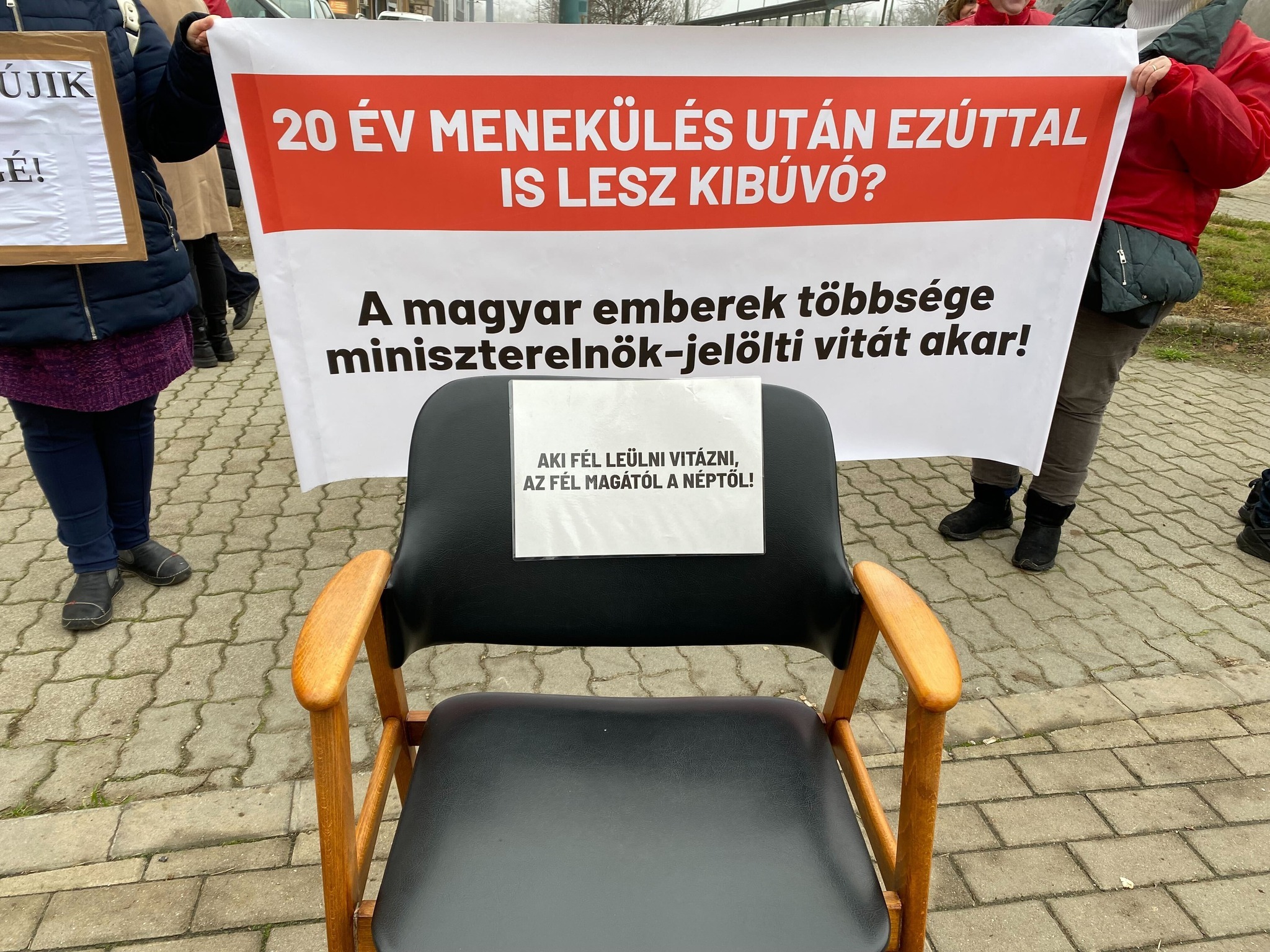
We did the same at the other stops of Viktor Orbán's national tour. After Győr, we went to Nyíregyháza, Mohács and Szeged too. Our message was clear: anyone afraid to sit down and debate is afraid of the people themselves. We symbolized this with an empty chair at the venues of the DPK meetings.
Watch our summary video by clicking on the image:
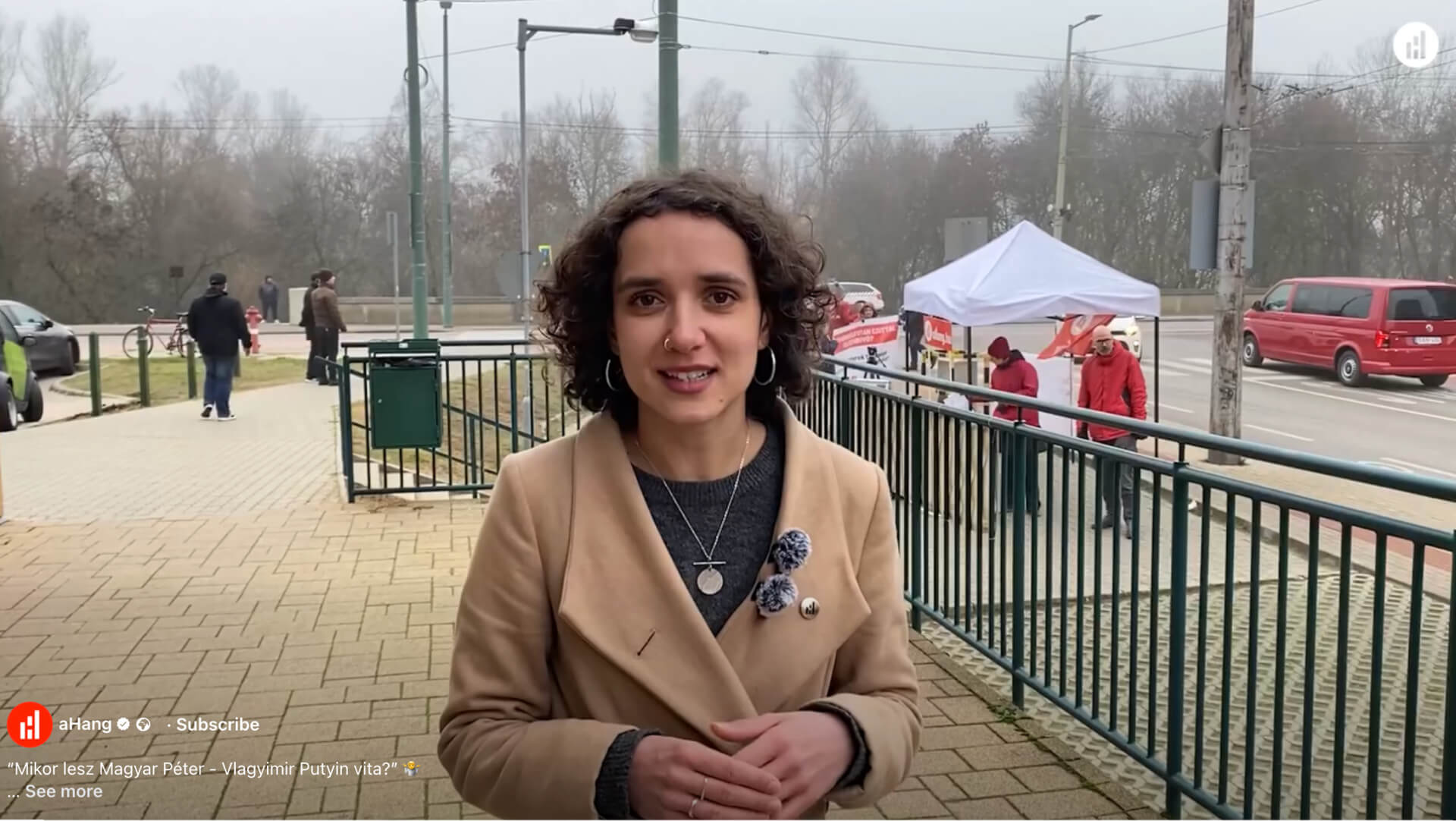
Our campaign continues. So far, more than 65,000 people have joined our petition, and we are working to ensure that our message reaches as many people as possible: a debate is not a favor, not a campaign stunt, but a political duty. And if, after 20 years, Viktor Orbán still does not dare to stand up and debate, then it must be said: he is a coward, afraid to defend his position in public.
International Election Observers To Arrive - SUCCESS!
With the 2022 parliamentary elections, Hungary became the first EU Member State where the Organization for Security and Co-operation in Europe (OSCE) launched a full-scale election observation mission. At the time, the OSCE report made it clear that the election campaign had not been conducted on a level playing field. In July 2025, we launched a petition calling for international election observers to be deployed for the 2026 elections. We launched this campaign so that, after the election, we would be able to see clearly what exactly happened on 12 April and in the months leading up to it.
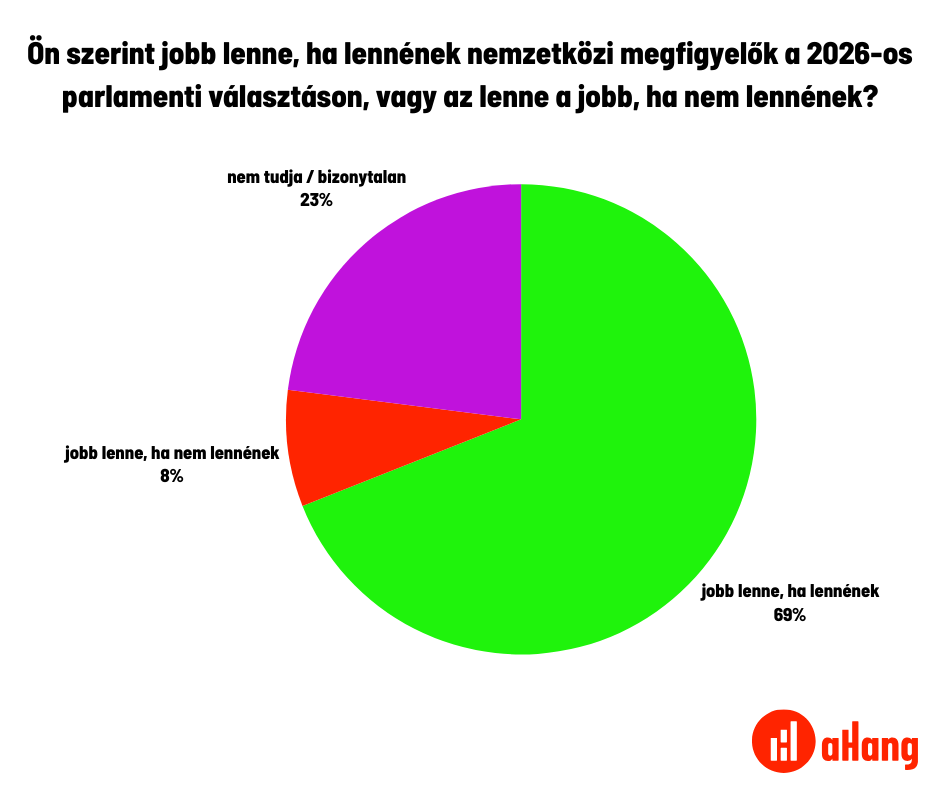
When we launched the petition, our goal was 20,000 signatures, which we reached very quickly. Then, in September, we commissioned our first opinion poll, asking: "Do you think it would be better if there were international observers at the 2026 parliamentary election, or would it be better if there were not?" More than two thirds of the population (69%) answered that it would be better to have international election observers, and even 59% of Fidesz voters supported our proposal.
We Delivered the Will of Hungarians to Fifty Countries
The OSCE met in Warsaw on 6 October. We travelled to the event to publicly present our request to every member state: after 2022, election observers should once again come to Hungary. We handed tens of thousands of signatures directly to representatives of the member states. Our Campaign Director, Enikő Tóth, also gave a speech; the recording can be watched here:
In December, the OSCE Office for Democratic Institutions and Human Rights (ODIHR) sent a needs assessment mission to Hungary, where over a few days it consulted with civil society organizations, political parties and representatives of the media. Our campaign was ultimately successful: by January, more than 60,000 people had signed the petition, and the OSCE report presented on 21 January recommended that international observers be deployed. In numbers, this means 18 long-term observers will arrive to follow the campaign across the country, while 200 people will monitor developments on election day.
This Is Why the Country Is Where It Is
Because of rising prices, the state is managing record amounts of VAT revenue. High-profile prestige investments keep following one another. Until not long ago, unimaginable amounts of EU money were flowing into the country. But who is better off as a result?
The answer is certainly not healthcare, education, child protection, elderly care or infrastructure — in other words, not the areas that are indispensable for all of us. A narrow circle has profited from all this.
Because of political will and the economic interests of a narrow power elite, Hungary has not moved forward in international rankings; on the contrary, the country is sliding downward. But who are the members of this political and economic elite? Who are the people because of whom the country is where it is?
We wanted to find answers to these questions, so we created a collection of more than one hundred political and economic actors: people whose decisions, failures or corrupt business dealings have deprived us of a livable future and a thriving country.
During our months of research, we found evidence that Fidesz's leading politicians and the economic elite linked to them have now woven their network across the entire country. This is what we show on lopnak.hu, our website launched in October 2025. It gives people the facts and arguments they need to understand the government's failures and the scale of corruption — and to convince others too.
Several proven or suspected corruption cases — such as the Elios case or the Völner-Schadl case — are linked to multiple actors. We are talking not only about nationally known politicians and oligarchs, but also about locally influential figures — constituency MPs among them — who spent public money on investments that did absolutely nothing to serve the people living there. This is how we became the country of the snail farm, horse wellness and the treetop walkway without trees — while healthcare is held together only by the dedicated work of committed staff, education is unable to help people rise, and even hard work no longer gets us ahead.
Light in the Darkness
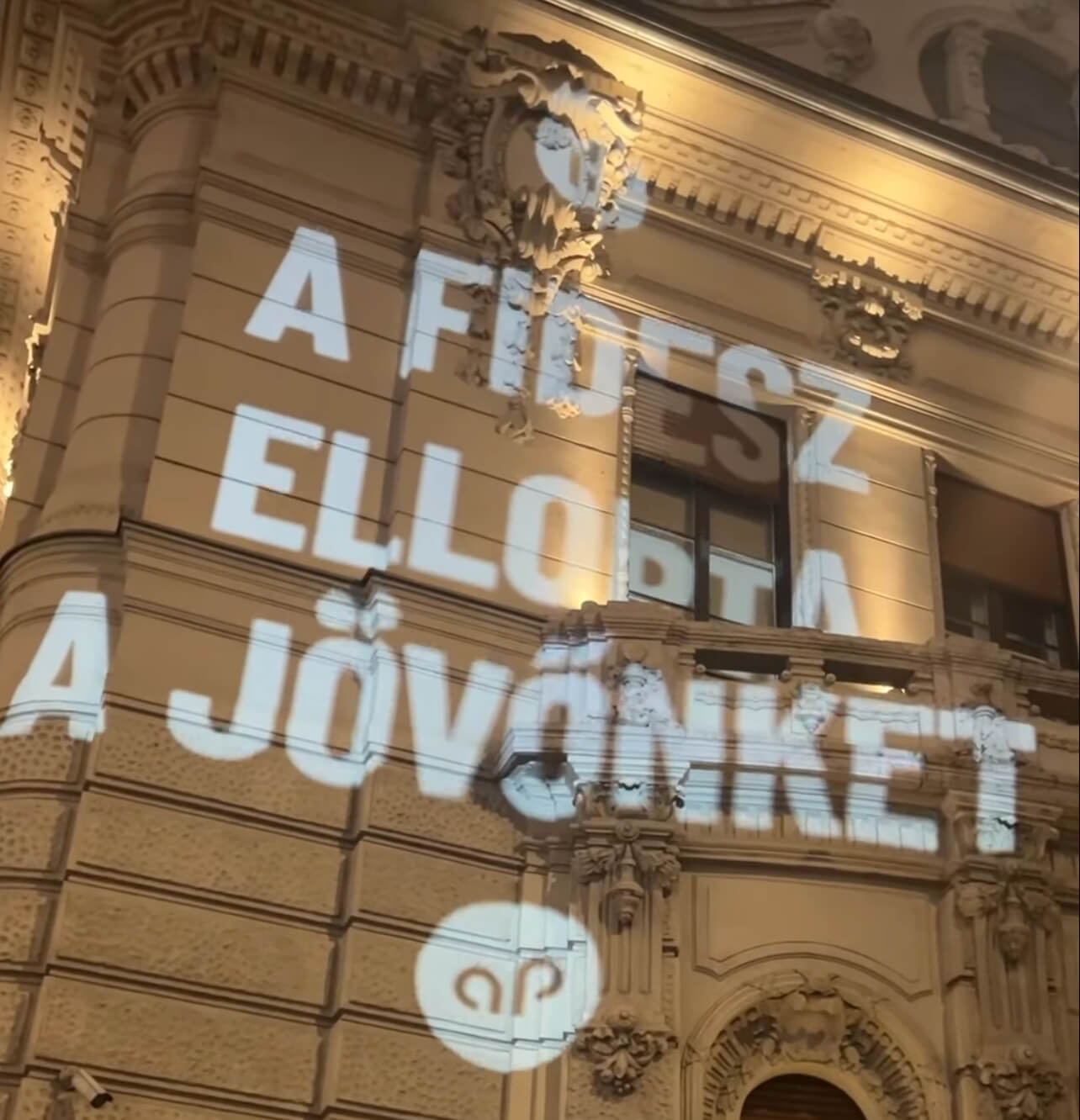
This is what we drew attention to on December 9. After dark, we projected our message onto numerous buildings linked to Fidesz: "Fidesz Stole Our Future" — along with the address of our website, lopnak.hu.
We went to Andrássy Avenue, where, as early as 2022, 60% of the palaces were in the hands of oligarchs close to Fidesz. We went to Kunigunda Road, home to the public media, which operates with a budget of more than HUF 150 billion. We also stopped at several ministries, before projecting our message for longer onto Fidesz's headquarters on Lendvay Street, so that every passer-by would be confronted with it: Fidesz stole our future.
Watch our video about this by clicking on the image!
Enough of the Propaganda!
The public media, operating with more than HUF 150 billion, has a legal obligation to provide balanced information; instead, it spreads messages favorable to the governing parties, often outright lies. The pro-government KESMA (Central European Press and Media Foundation) controls hundreds of media companies. It keeps losing press lawsuits one after another.
For all these reasons, on 26 November we organized a nationwide day of action against propaganda at nearly twenty locations across the country. Budapest, Pécs, Békéscsaba, Gyula, Miskolc, Szeged, Makó, Szentes, Hódmezővásárhely, Székesfehérvár, Szolnok, Esztergom, Salgótarján, Dunakeszi, Nyíregyháza, Kisvárda, Záhony, Kecskemét and Veszprém all said simultaneously that they reject the lies of government media. The actions were covered by the remaining independent media, including Telex.
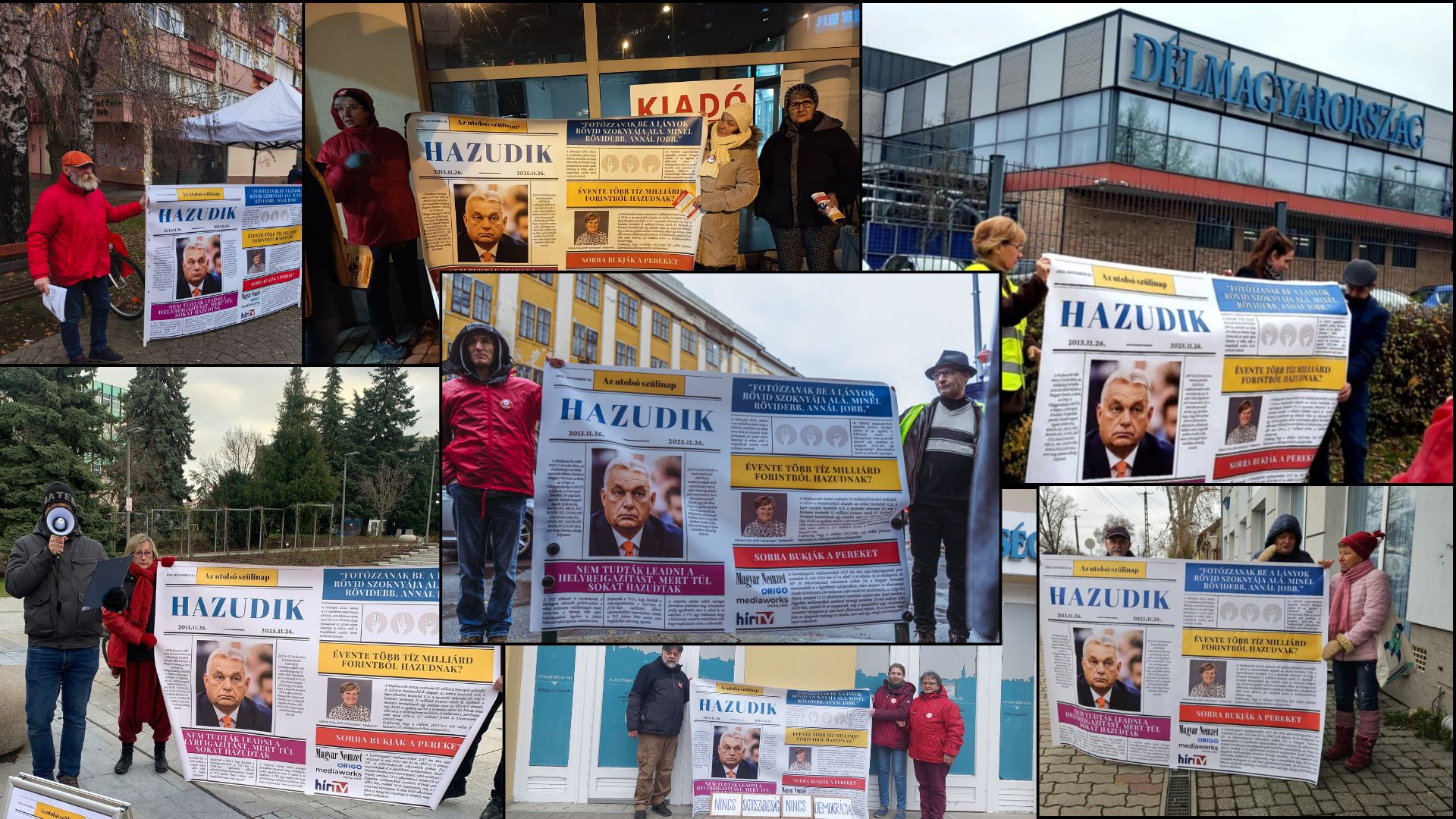
Since then, we have expanded lopnak.hu to include pro-government media outlets. Most of these operate on open or hidden state support. The latter works like this: the government orders large volumes of ads and advertisements in pro-government media outlets so that, on the one hand, people are flooded with Fidesz messages paid for from public money, and, on the other, vast amounts of public money are channelled to the owners of these media outlets — especially to the advertising companies of Gyula Balásy, whose fortune is estimated at around HUF 100 billion.
We have long challenged the government's national consultations: with its leading questions and answer options, this institution does not measure society's real problems and views, but hammers home the governing party's message in the guise of questions. In 2024, as a protest, we collected around 400,000 national consultation sheets: 400,000 of us said no to government propaganda.
After the national consultation launched at the end of 2025 closed, we submitted a freedom of information request. Among many other questions, we wanted to know where, and for how much, the government advertised the national consultation. The numbers are staggering: between October 1 and December 7, 2025, the government advertised the national consultation on 142 news websites, in 136 print publications, on 33 radio stations, and across 63 television channels. The Cabinet Office of the Prime Minister spent a total of HUF 8.3 billion on the campaign. The ministry signed the framework agreement with Gyula Balásy's companies, New Land Media Ltd. and Lounge Design Ltd. Most of the media outlets involved are linked to Mediaworks, as well as to Village Media Ltd., which operates a network of hyperlocal media outlets.
There are therefore hundreds of media outlets through which Fidesz's messages are advertised — all from public money that is desperately needed in areas such as healthcare or railway development.
We present these media outlets on the propaganda subpage of the National Wall of Shame. Take a look for yourself — click here or on the image.

Clean Vote
Since autumn 2025, we have met people in several cities across the country who do care about the approaching parliamentary elections. In Salgótarján, Makó, Veszprém, Pécs, Miskolc and Nyíregyháza, rooms were full when we talked about clean elections, the inequalities of political competition and civic responsibility.
With this series of events, our goal is to show in an accessible way that election integrity is not merely a legal question, but a common cause for all of us. Experts from the ACT coalition (aHang, the Civil College Foundation and HCLU), as well as Political Capital, helped us better understand how the electoral system is distorted and what tools can nevertheless strengthen democratic functioning.
At aHang, we continue to work to make sure this message reaches as many people as possible: democracy is not a given, but a shared responsibility. And the more of us take an active part in it, the greater the chance that elections can truly be transparent.
For more useful content, visit tisztaszavazas.hu.
The cooperation is supported by Civitates — The European Democracy Fund.
Our Successes
Our Successes
We Were There at Budapest Pride Alongside Hundreds of Thousands
This year, we also took part in the massive Budapest Pride march, because we believe that love is a human right. aHang's Budapest group, the aPoint, prepared various programs and represented our organization in one of the tents in the NGO village. Activists and volunteers from Budapest as well as from other cities staffed our activities throughout the day, using games to engage participants and introduce them to our work. Our team and community are proud that we once again stood up for human rights.
We Stopped Government Propaganda in Cinemas
On the last weekend of November, news broke that the Cinema City cinema chain was screening government advertisements before the children's film Zootropolis 2. In response, we launched an email campaign, and within two days nearly a thousand people emailed the cinema chain, asking it to stop showing the advertisement.
In our email campaign, we asked Cinema City to stop the practice that results in government or other political content being shown before children's films, because this can further erode the quality of public communication. In our letter, we also emphasized that "the viewers in question are children and their families, who are entitled to expect that they will not be exposed to attempts at political influence during an entertainment program."
The company responded, writing that the advertisement in question would be removed from the ad block. As they put it, they understood that many cinema-goers do not want to encounter such advertisements.
They have since confirmed that they will not accept advertisements similar to the government ad we objected to.
This success was only possible because people acted quickly and together. It is also a clear answer to a question we are often asked: do petitions really make a difference? This year alone, we have won victories on both local and national issues, and each of them shows the same thing: when enough people speak up, decision-makers are forced to listen. This case is another example. Petitions give people a way to stand up for a freer, calmer, and more decent public life — one where politics does not intrude even into our leisure time.
We thank the nearly one thousand people who stood up in defence of children and public discourse and sent a message to Cinema City. We trust that the cinema chain has understood that government propaganda has no place before films.
The M30 Motorway Is Open Again
After thirteen months of persistent work, the section of the M30 motorway that had been closed for nearly two years has finally reopened. In December 2024, we launched a petition demanding that reconstruction begin as soon as possible, that the financial damage suffered by residents be mitigated, and that technical measures be introduced on the overloaded sections of Main Road 3 for the duration of the closure. Our local group, the Miskolc aPoint, also created a website showing in numbers the daily losses caused by traffic jams, and continuously updated the campaign news and the status of our demands.
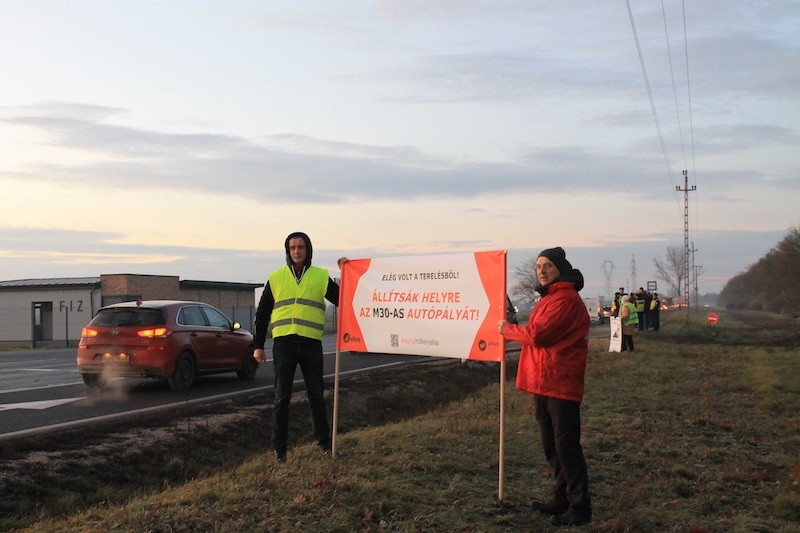
The local group's first high-visibility action was a dawn demonstration beside Main Road 3, when traffic jams were at their worst. Despite the cold, they handed out leaflets, held banners and collected several hundred signatures during the morning rush hour.
Then came an unexpected turn: János Lázár arrived in Miskolc for an off-site ministry meeting to support the newly elected mayor. Our activists waited for hours outside the office, eventually handed over our demands in person, and invited the minister to the planned public forum.
We held the forum in February, where we clearly presented our expectations: a motorway toll discount, technical solutions to reduce traffic jams, a concrete deadline for restoring the collapsed road section, and the creation of a working group in which we would also take part. At the forum, the minister promised to fulfil these.
But our work did not stop there. We sent more than thirty official letters to decision-makers, continued the dawn demonstrations, and made videos on the closed motorway section to keep public attention on the problem.
The results were tangible:
- the expansion of the Arnót roundabout was completed within a few days;
- the motorway-use discount was enshrined in law and took effect in 2026;
- STRABAG, the construction company responsible for the project, completed the reconstruction by the agreed deadline, and the road section was technically finished.
Although Fidesz attacked STRABAG throughout, we did not let up the pressure: we made further on-site videos and asked the signatories of the petition to have their say in the decisions. The result of this shared perseverance was that on the penultimate day of 2025, the M30 motorway reopened to traffic.
This victory did not happen by itself. It was the result of collective work. Thanks to the persistence of the activists of aPoint Miskolc, the M30 is open again!
The Cause of European Women Reached the European Commission
My Voice, My Choice is a European Citizens' Initiative whose aim is to ensure access to safe and free abortion for women across the European Union, even if abortion is currently illegal or difficult to access in their own Member State. For the European Commission to put the initiative on its agenda, at least one million signatures had to be collected across Europe.
For Hungary, the proportional target was 14,805 signatures. We not only reached this, but exceeded it by more than a thousand. This is a huge achievement.
And we have more good news: at European level, it has now been officially confirmed that the required number of signatures was collected, with more than 200,000 more statements of support than the minimum requirement. As a result, the European Parliament debated the issue and called on the EU to establish a comprehensive and binding framework to ensure full and equal access to sexual and reproductive healthcare services. It also proposed that the right to safe and legal abortion be included in the Charter of Fundamental Rights of the European Union.
We Stood Up for the Lecturers of Pázmány Péter Catholic University
Disciplinary proceedings were launched against several lecturers at Pázmány Péter Catholic University on suspicion of an ethical violation after they expressed their professional and personal convictions in a June article in HVG. They said that, as lecturers at a Christian university and as psychologists, they believe that every relationship based on love is of equal value, and that research shows no difference between the children of same-sex and heterosexual couples across various developmental indicators. The university responded by launching disciplinary proceedings against the lecturers and trying to dismiss them from their jobs.
In response, a petition was launched in support of the lecturers, and within a few days nearly eight thousand people had signed it. Then, in July, the good news came: the lecturers would not be dismissed, and the disciplinary proceedings were closed.
There Will Be No Tolerance Zone Next to a Children's Home in Miskolc
In the autumn, news broke that in Miskolc a "tolerance zone" (a legally designated prostitution zone) was to be designated directly near the Fruska Special Children's Home. For us, this clearly ran counter to children's right to safety and healthy development. We could not remain silent.
aHang's local group, aPoint Miskolc, demanded that the city assembly reject the plan with immediate effect, and that the city leadership, in consultation with the police and MESZEGYI (Miskolc's integrated social, health and child welfare institution), designate a new location. Our goal was for the tolerance zone to be placed at an appropriate distance from all child protection and public education institutions. The Miskolc team initiated a legality review at the government office, spoke at the public hearing, consulted with the city leadership, and visited possible locations — the present success is the culmination of that process.
In the end, the Miskolc City Assembly designated a new location — another victory for us in Miskolc!
aPoint Overview
aPoint Overview
The aPoint Network Grew Stronger
By the beginning of 2026, our aPoint network had grown larger than ever before. We now have local aHang activist groups — aPoints — in 12 of Hungary's 19 counties, as well as in Budapest. aPoint members launch and win local campaigns as groups, and also represent aHang's national campaigns locally. At the same time, they build community, learn campaigning skills through aHang training courses and hands-on experience, and help local people successfully make their voices heard on a wide range of issues.
Over the past six months, four new colleagues have joined our network: Hajnalka Lévai became our county coordinator in Bács-Kiskun, Tibor Urbán joined us as coordinator in Győr-Moson-Sopron, Erika Fábián now coordinates the aPoint in Komárom-Esztergom, and Ágnes Magyar-Ábel launched our local organizing work in Pest County. We warmly welcome them all!
As a result, by the beginning of 2026 we were present in most Hungarian counties — in several of them with more than one group. Counties with aPoints now include Bács-Kiskun, Baranya, Békés, Borsod-Abaúj-Zemplén, Csongrád-Csanád, Győr-Moson-Sopron, Jász-Nagykun-Szolnok, Komárom-Esztergom, Nógrád, Pest, Szabolcs-Szatmár-Bereg and Veszprém, as well as Budapest.
We provide our volunteers with training in civic advocacy, campaigning and effective teamwork. Twice a year, we also gather from every corner of the country to connect in person, instead of only online, to learn from one another — and, of course, to work together on aHang's campaigns. That is why our 2025 summer gathering was such an important milestone: over seventy of us took part, more than ever before.
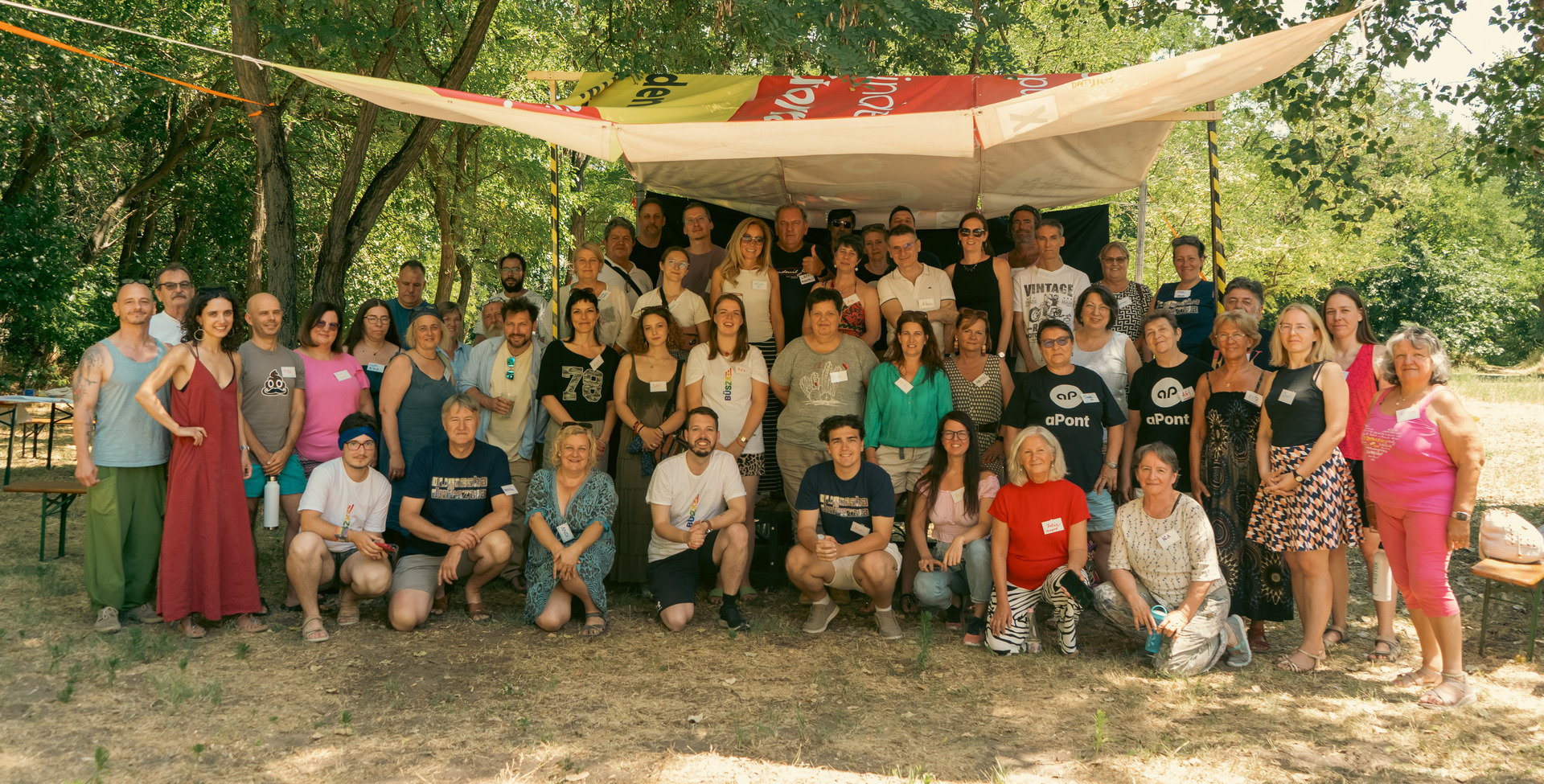
You can also read about the activities and successes of the aPoints in this publication — we are immensely proud of our volunteers and county coordinators.
Reports from Our aPoints
Budapest
The Budapest activist group set itself the goal of organizing actions every month. Their aim was to draw attention to key issues in the capital and help aHang's messages reach a wider community, often through playful, creative actions that use humor to expose absurd situations.
In July, they set up a booth in the NGO village at Bánkitó Festival, and in August they organized a public action by City Park Lake, featuring games that satirized governing-party politicians' luxury summer spending and the systemic appropriation of tax-funded public money. Their custom-designed NERopoly board game, the "Where is the public money?" game, and the tilted-pitch NER table football all combined entertainment with a serious political message.
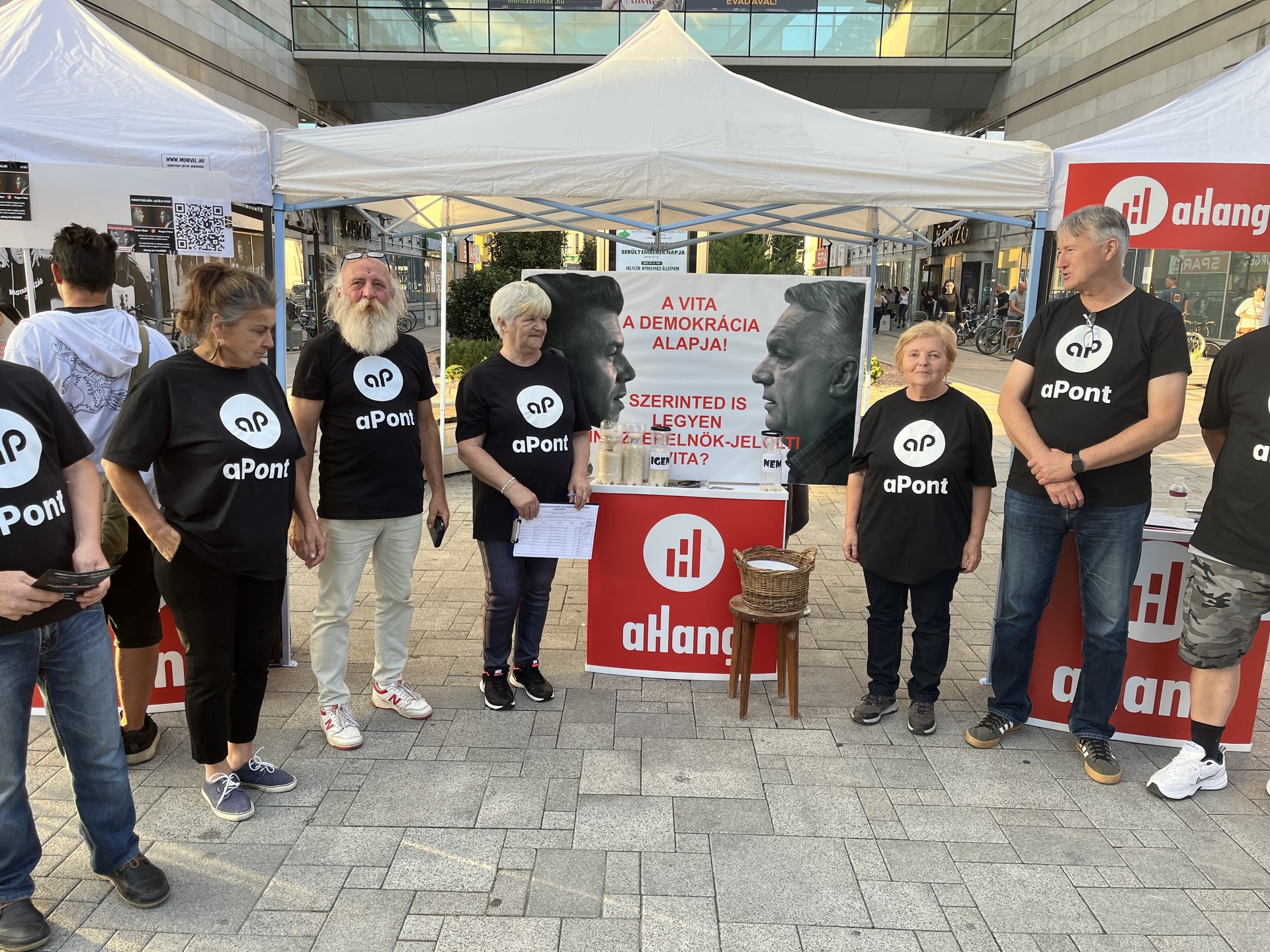
On September 15, the International Day of Democracy, they set up campaign stands at 10 locations across Budapest in support of a prime ministerial candidate debate between the strongest candidates, gaining nearly 500 supporters for our cause on the streets of the capital in a single day.
We also dealt with social problems affecting broader groups. On the International Day of the Girl Child, 11 October, we were able to speak without taboos about period poverty at a roundtable discussion held at Manyi in Buda. In addition to raising awareness of the problem, our goal is for free menstrual pads to be available in multiple public institutions in every municipality.
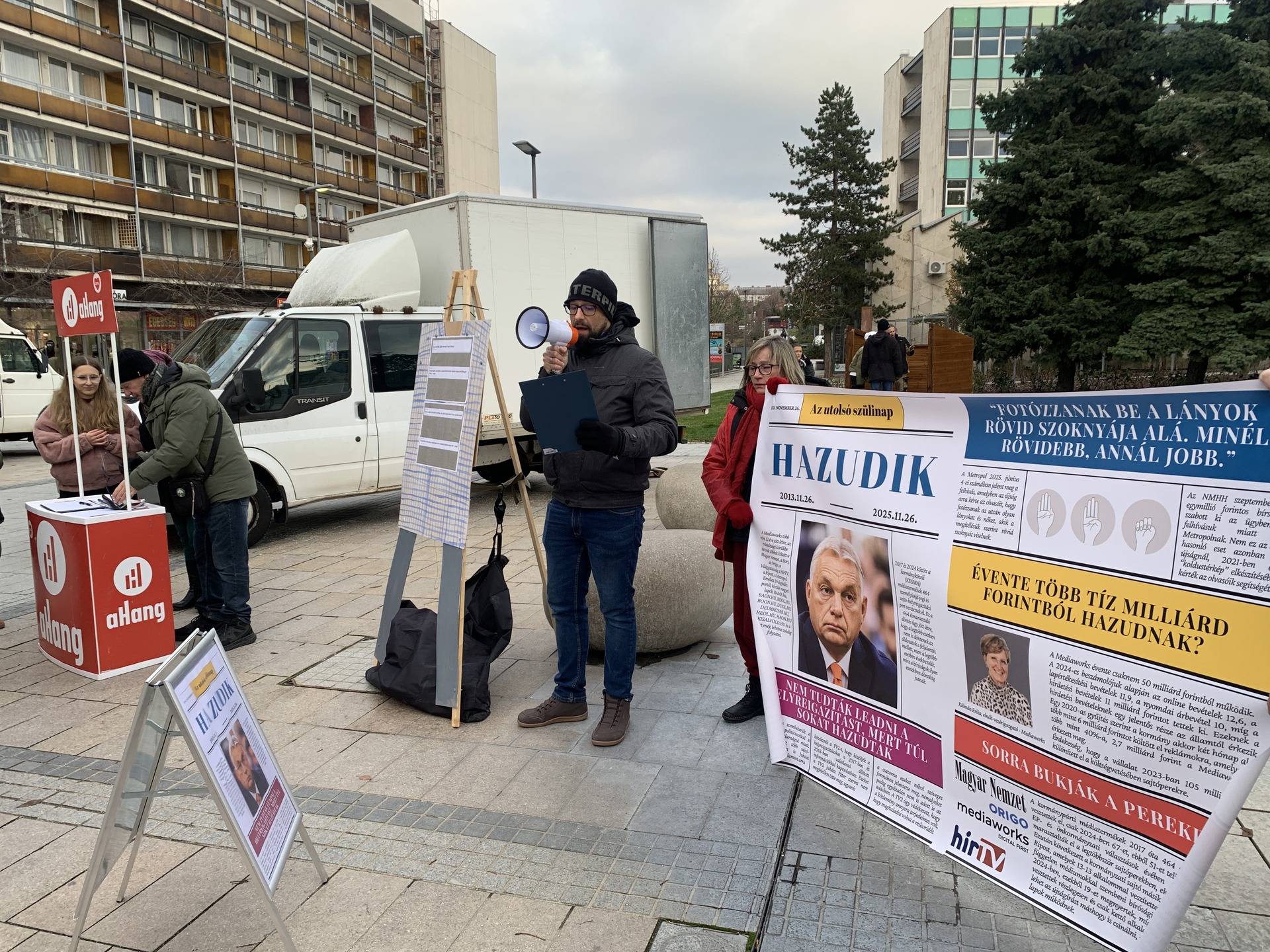
The special issue of MertLopol ("Because You Steal"), edited by members of our Budapest aPoint, was a great success. It borrowed the visual style of the Metropol newspaper, but instead of fearmongering propaganda pieces, it featured — unfortunately only imagined — good news. The self-made publication was created for the 12th, and hopefully last, birthday of Mediaworks, the publisher of Metropol and the inspiration behind the parody.
On November 26, during a short flash mob, we even gave a copy to Mediaworks employees and asked activists to leave copies around the city. The unsuspecting readers who found them got more than a few cheerful moments out of it.
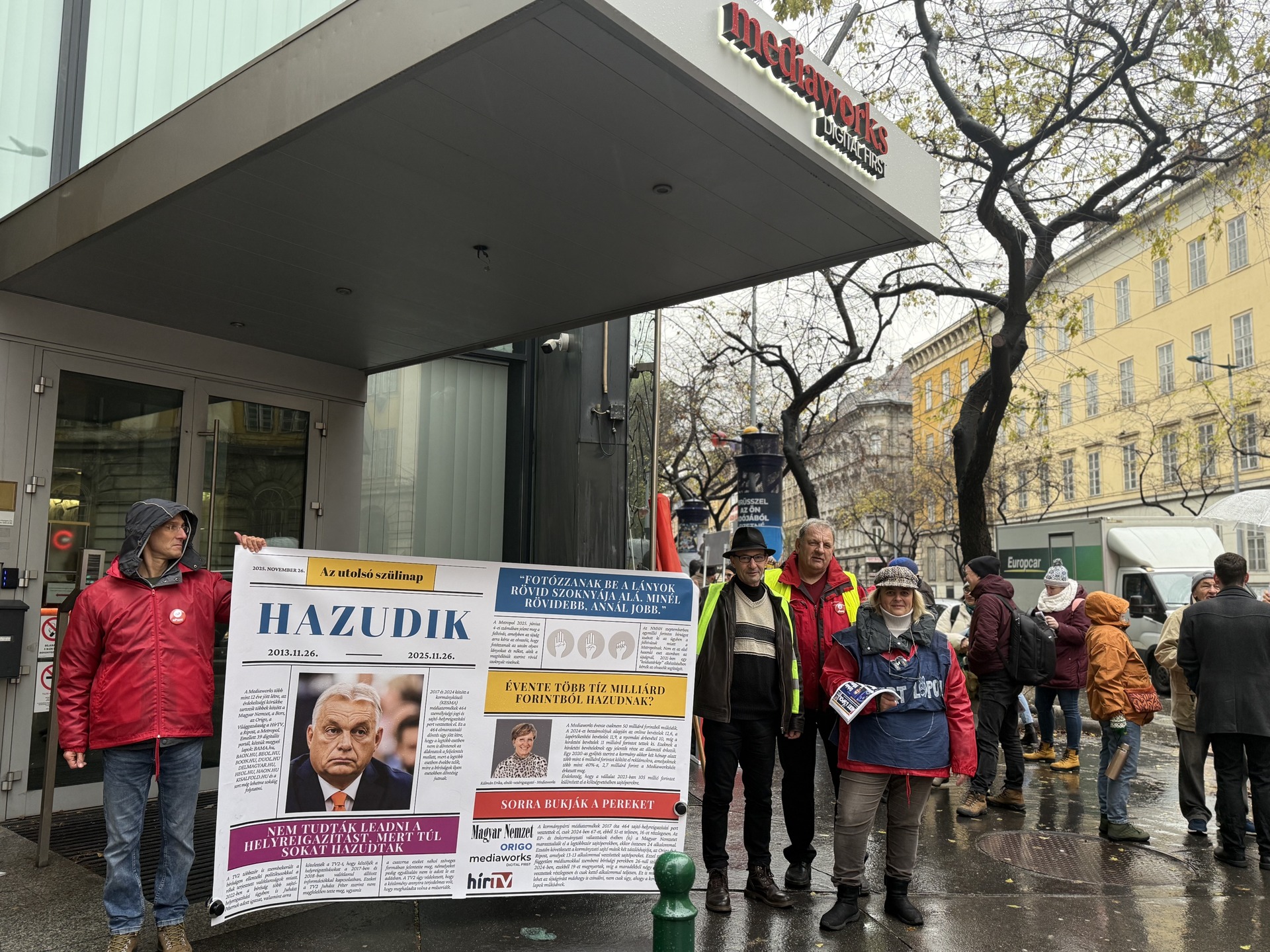
At the end of the year, our Budapest activists also took part in our demonstrations ahead of the Digital Civic Circle (DPK) meetings, where we brought an empty chair to show that our current prime minister is too cowardly to sit down for a debate. They also helped other aPoints — for example, when the Borsod and Szabolcs groups traveled to the capital to hand over their petitions in person at the Ministry of Construction and Transport.
"For me, the greatest experience of the past six months was feeling that, through continuous expansion, the coordinators are beginning to become a real team. Along the way, taking part in Pride, Bánkitó, and a shared working holiday also brought us closer together. Beyond regular consultations, coordinators from different parts of the country, mostly working on local issues, have helped and inspired one another, weaving the aPoint system into a strong network. This cooperation strengthened the sense of unity across our network."
Eszter Békefi, aHang's Budapest coordinator
Baranya County
aPoint Pécs began organizing in August 2025, in response to the increasingly strong local activism visible in Baranya. It became clear that local people needed a community through which they could make their voices heard on the issues that affect them.
On 15 September, the Baranya team actively joined the national campaign calling for a prime ministerial candidate debate. At their campaign stands, they met interested people at several locations in Pécs — in front of POTE, at the Árkád shopping center and around the market hall — and then continued collecting signatures in Szigetvár. Interest was strong everywhere: many people joined, a large number of signatures were collected, and the encouraging feedback was just as important. These occasions went beyond signature collection, as countless personal stories emerged from the conversations.
In October, a significant local issue came into focus. On 13 October in Bicsérd, the Pécs aPoint held an alternative public forum titled "Have Your Say, Bicsérd! — the Future of Our Land and Our Community." In the community near Pécs, the government plans to expropriate 600 hectares of farmland to build an industrial park, without meaningful information or genuine involvement of residents; the petition on this issue can be found here. The mayor and his team, who support the investment, also appeared at the forum, and an open and tense debate unfolded among those present. Two weeks later, the residents of Bicsérd received an invitation to an official public forum from a civil society organization led by the local general practitioner, who had also attended the street forum organized by our Baranya activists (he argues in favor of establishing the industrial park). The so-called expert forum he organized was clear proof that local voices and the power of publicity do have an impact.
At the end of October, the Clean Vote workshop discussion was held in Pécs, organized by the ACT coalition (aHang, CCF and HCLU). It featured an engaging presentation and discussion about election integrity and the exercise of citizens' rights. The strong turnout and active participation made it clear that these issues resonate with many people in Pécs, too.
In November, we were active on several important issues. On November 12, we also stood up for Gábor Iványi and his community at a demonstration. At the 150–200-person gathering, the Pécs aPoint made clear that it considers politically motivated show trials unacceptable and stands with everyone facing intimidation for political reasons.
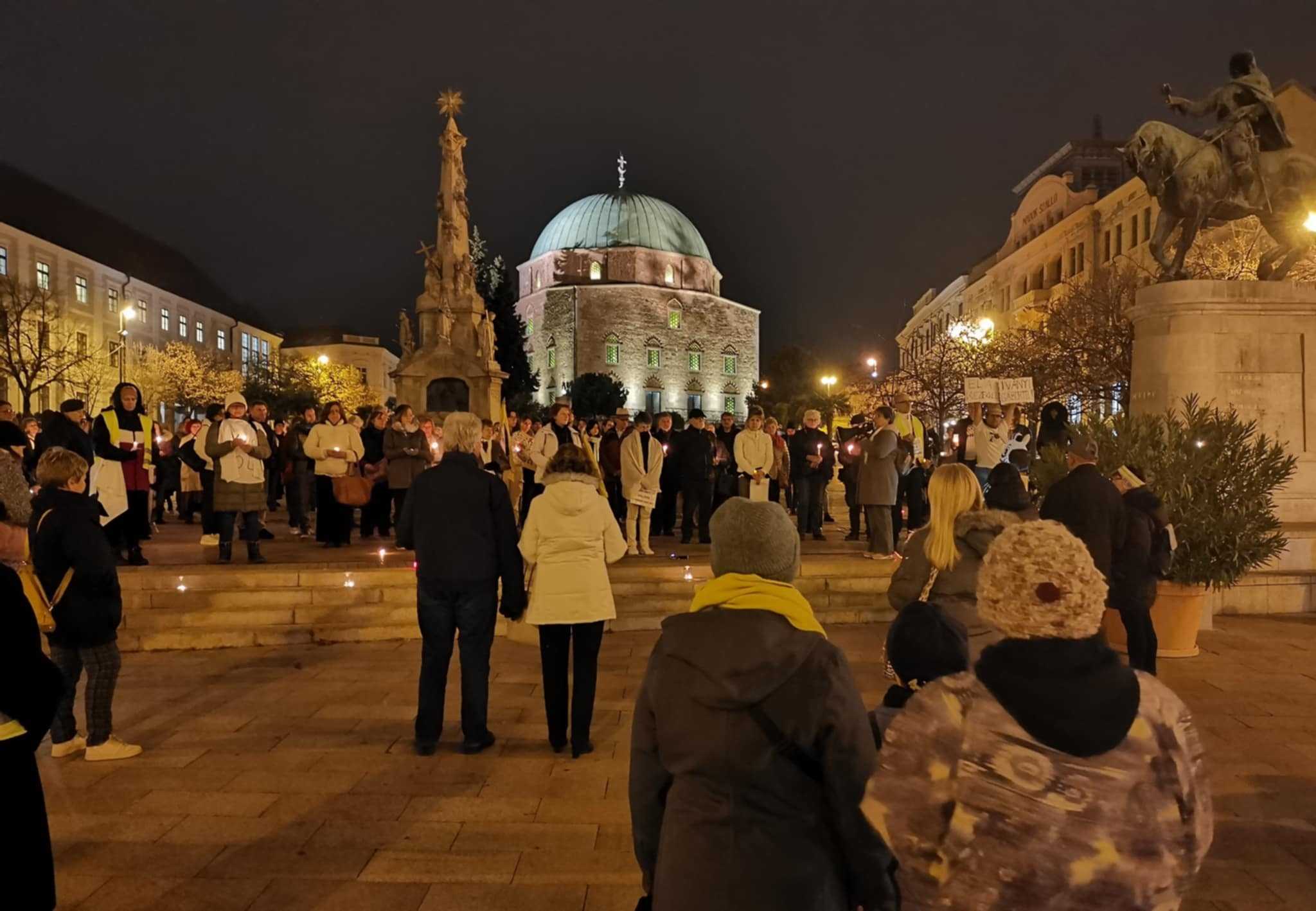
On 26 November, the "propaganda day" announced by aHang, the local aPoint in Pécs also organized a demonstration and march, with several hundred people taking part. At the headquarters of the local Mediaworks paper, Dunántúli Napló, Dr Péter Heindl, lawyer and civic activist, spoke about the publicly funded propaganda system, its social effects, and why consistent local civic action is needed.
We did not slow down in December either. On 10 December, local activists held a solidarity action in support of Géza Buzás-Hábel, one of the organizers of Pécs Pride, who had been subjected to official proceedings. The aim was to make clear that they do not accept anyone facing retaliation for peacefully and lawfully standing up for human rights.
aPoint Pécs also remains in continuous contact with the participants of the "Enough!" white-clad silent demonstration, held every Wednesday since 26 March. Week after week, these gatherings remind us that there are many who refuse to resign themselves to lies, theft and autocratic rule.
The aPoint Pécs community continues to grow. More and more people are joining, and new aPoints — local aHang groups — are currently taking shape in Bicsérd and Mohács.
"There has always been a strong civic presence in Baranya, yet many people cannot channel their social and political dissatisfaction into action. I was delighted to see that the formation of aPoint Pécs worked almost like a magnet: many activists and volunteers joined the group, creating an opportunity for them to make their voices heard on local and national issues and put pressure on those in power. Besides Pécs, our activists are also organizing in Bicsérd and Mohács. I am proud of this brave, active team, who are working to bring change to Baranya, too."
Orsolya Varga, aHang's Baranya County coordinator
Békés County
In Békés County, the second half of the year brought small changes in how events were organized compared with earlier practice. The activist group operating in the county shifted from longer-term event series to a more flexible, responsive mode. As a result, local activists increasingly took the initiative on issues they felt strongly about, speaking out and taking action when they believed it was necessary. This brought them much closer to a direct experience of democracy: speaking up for shared values in a way that others can join.
As a result, the group's activities in the second half of the year were highly diverse. From online discussions and candlelight vigils to street outreach, activists engaged with local residents in many different ways.
At the beginning of the six-month period, prompted by the national summer protests, the Csabai Hangadó (Békéscsaba Voices) online discussion series focused on the right of assembly. Our guest was Dániel Döbrentey, an expert from HCLU, with whom we explored a wide range of questions, with active participation from those attending. Building on this knowledge, we organized Citizen Participation Day in October in response to a call from the Civil College Foundation. Alongside playful presentations of local issues, participants also reflected on systemic problems such as outmigration and corruption, both of which have a strong impact on the county. During the event, following the announcement of László Krasznahorkai's Nobel Prize, passers-by could draw surprise quotes from the Gyula-born writer and take them home as keepsakes.
At the Békéscsaba screening of Direkt36's film Dynasty, where the filmmakers were also present, there was room for a more direct conversation. Participants became deeply engaged in the discussion, making the event not only warm and engaging, but also a genuine opportunity for attentive dialogue.
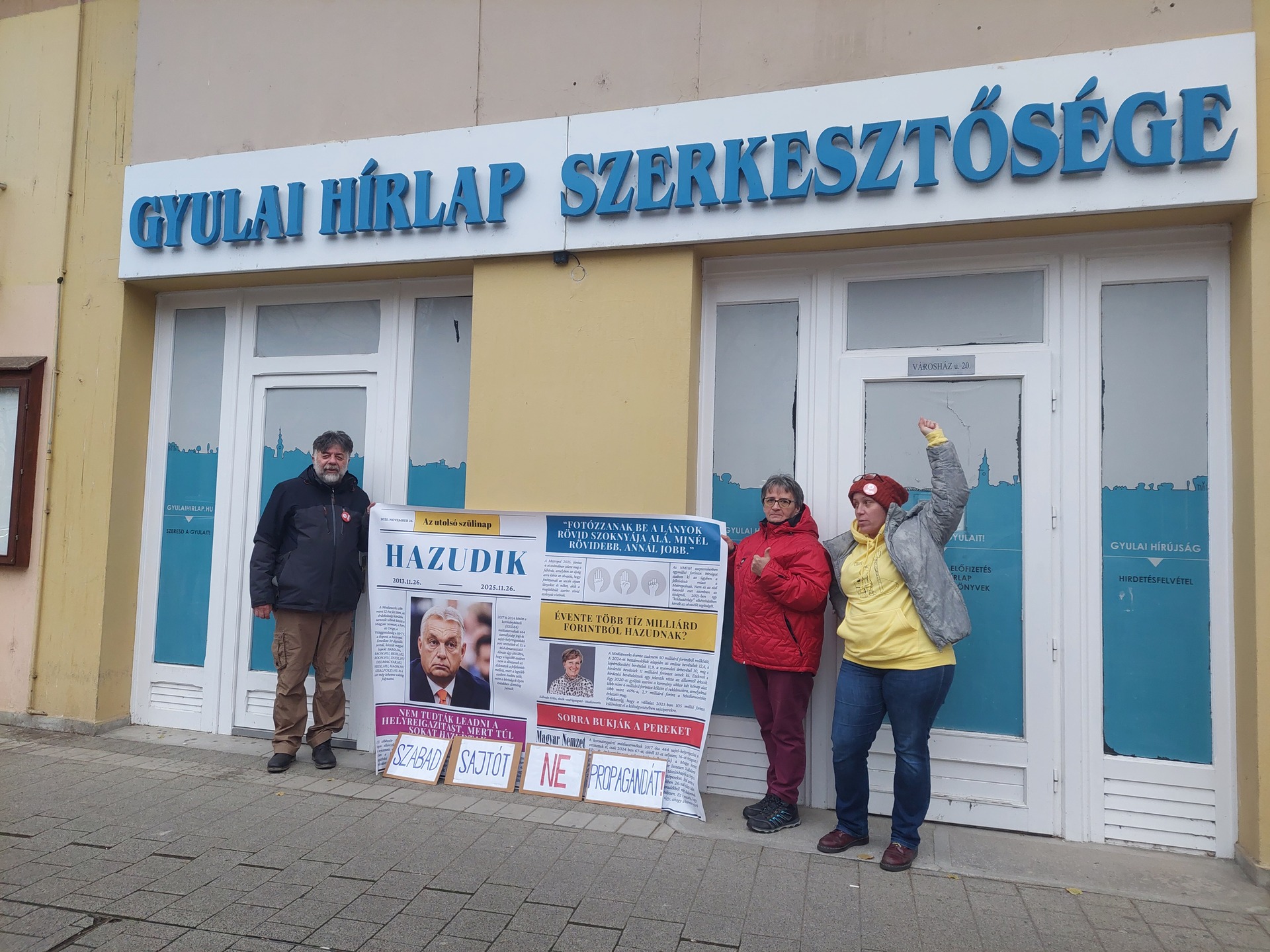
The largest street action of the six-month period was the demonstration against propaganda in Gyula, followed by another in Békéscsaba at the end of November. Many people joined on site, and the action was also covered in the news — an especially strong sign of encouragement for the team, given the local context.
Several developments in public life also prompted spontaneous reactions: a quiet and dignified candlelight vigil in support of Gábor Iványi's church, and, in response to the child protection scandals, an action with plush toys and signs showing that national issues always have an impact even in places farther from the capital.
News about petitions launched on local issues and national campaigns now reaches local residents through two aPoint Facebook pages. In addition to the Békéscsaba page, the Orosháza page also helps people stay informed and shares reliable news with followers and interested residents. Our most significant issues in Békés County included the "suspension" of services at the Orosháza hospital, the lack of information around an industrial development affecting the county seat, and the need to involve local residents in decisions.
"By the second half of 2025, the approaching election was already in the air. Every action and every encounter required much greater care, because expectations and emotions were rising — while public issues were changing so quickly that every moment of success and joy melted away fast, and every outrage was followed by an even bigger scandal. Still, the best experiences came from shared public actions, where people were grateful for the chance not to face their frustration alone, but to find common ground, contribute to a cause, and channel their needs into expectations and demands addressed to decision-makers. This situation required both new methods in coordination work and greater attention to detail. The expanding coordinator team and our mutually inspiring community gave me great support. It is a space where we can work through the details while keeping our shared goal in focus. It was an extraordinary experience to mentor a new fellow coordinator, which also gave me the opportunity to reflect on the many-sided work we do."
Ildikó Fazekas, aHang's Békés County coordinator
Borsod-Abaúj-Zemplén County
This was an intense and hard-fought six months, in which the harsh reality of Borsod tested our activists — the members of aPoint Miskolc — every day. While continuously responding to the hypocritical success messaging of local Fidesz representatives and countering the toxic effects of propaganda, they worked on three major local issues and two national campaigns to improve the lives of city residents and open new channels for action.
Local issues are never in short supply when the Fidesz-led administration of an underfunded county seat can do little more than echo national slogans while proving incapable of taking meaningful action on local problems. In August, for example, the team decided to take the issue of the burned-down Cave Bath into its own hands. They launched a petition, set up campaign stands, and found out that the city had classified the plans.
Using public procurement documents, the activists uncovered the reason for the secrecy: the billion-forint renovation would have left out therapeutic services that are essential to city residents and available through the public healthcare system. Although János Lázár, Katalin Csöbör, and local politicians tried to outbid one another with promises of development, in reality they were prepared to abandon the therapeutic section.
While the activists were still neck-deep in the Cave Bath campaign, the child protection scandal hit. The city leadership had designated a prostitution zone next to a girls' home whose residents are especially vulnerable to drug exposure and human trafficking. aPoint Miskolc launched a petition on the day the news broke and, within a month, achieved the impossible: the same body that had voted unanimously for the zone in October reversed its decision by the same unanimous vote in November, moving the sex work area a safe distance away from the children.
In the meantime, the team did not abandon the Cave Bath issue either. They organized a city walk and took part in a public hearing, confronting the leadership with uncomfortable questions. Faced with evasive answers, they stepped up the pressure: they traveled to Tiszavasvári for a Lázár Info event, and on December 5 organized a demonstration in Budapest in front of the Ministry of Construction and Transport. The pressure brought results: they were received at the ministry, the first phase of construction has since begun, and the fight now is to save the therapeutic section.
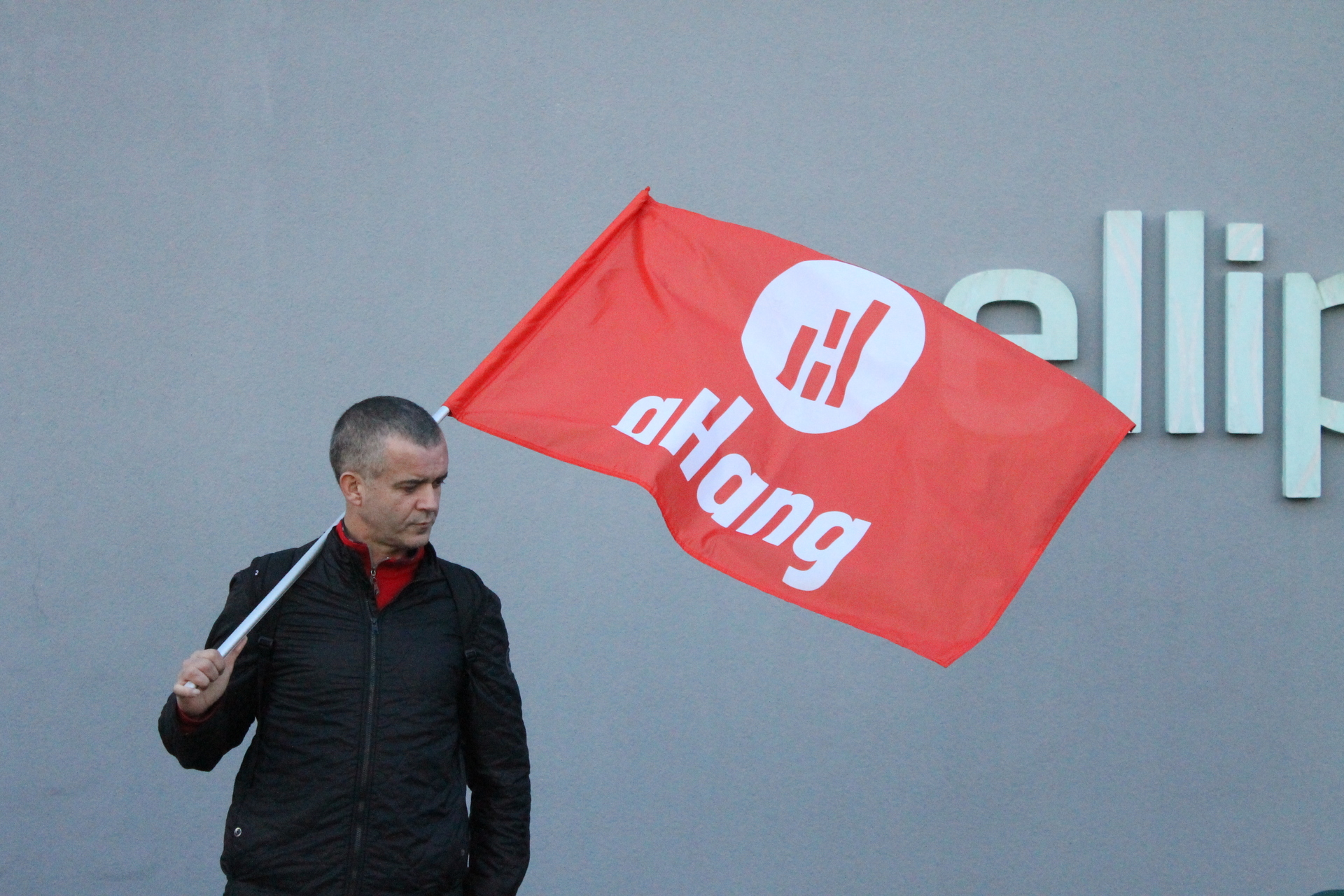
A third local success concerned the M30 motorway. When the delay became public, our activists' videos received more views than the total population of the affected communities. They demanded that the ministry not make local residents pay the price for the legal wrangling. The result: the road reopened on December 31, and the toll discount they had fought for became available to motorists on January 1, 2026.
As a local aHang group, they also brought national issues home. With a torchlight demonstration, they "celebrated" what they hoped would be the final birthday of the Mediaworks propaganda factory. On the second Sunday of Advent, they demanded justice for the victims of the child protection system in front of the Fidesz office. With plush toys and banners, they sent a clear message: the fate of the children of Szőlő Street, and of every victim, is a shared concern.
aPoint Miskolc proved that even in an absurd political environment, there is room for clarity and action.
"The lesson of these six months for me is that we were able to carry three local issues at the same time, while continuously responding to and taking part in national campaigns as well. We no longer join in by traveling 'up' from Miskolc to Budapest to the big national demonstrations; we organize them ourselves, here locally. These six months also brought new activists who, by speaking at demonstrations, credibly represent the voice of common sense. We ourselves have now become the conscience of Miskolc. After each success, our activists immediately throw themselves into putting the next good cause on the agenda. Our next goal is to amplify these issues across other communities in Borsod as well. We long for a kind of county-wide harmony — one that fits into the national melody, but where the score and the accents are finally written by us, here locally."
Lujza Sikoparija, aHang's Borsod-Abaúj-Zemplén County coordinator
Csongrád County
In Csongrád County, the Makó and Szentes aPoints were officially established, which means that, together with Szeged, we are now present in three cities with stable, active communities. On nationwide days of action, such as the anti-propaganda day in November 2025, we were able to organize demonstrations in four communities at the same time, showing the organizing power and commitment of activists across the county.
In the second half of 2025, the Makó aPoint worked consistently and persistently for arsenic-free drinking water. Our activists were present in every affected community, putting pressure on decision-makers through campaign stands, a public forum at the Makó water tower, regular awareness-raising actions, "crosswalk Wednesdays," and the handover of the petition. They placed information posters on the container supplying arsenic-free water and made sure they stayed up. Members of our aPoint also spoke at the public hearing, where they responded with substantive arguments to the deputy mayors' empty provocations. As a result of their continuous presence and consistent work, they were able to take part in a three-party consultation with Makó's leadership and the National Waterworks. The work continues.
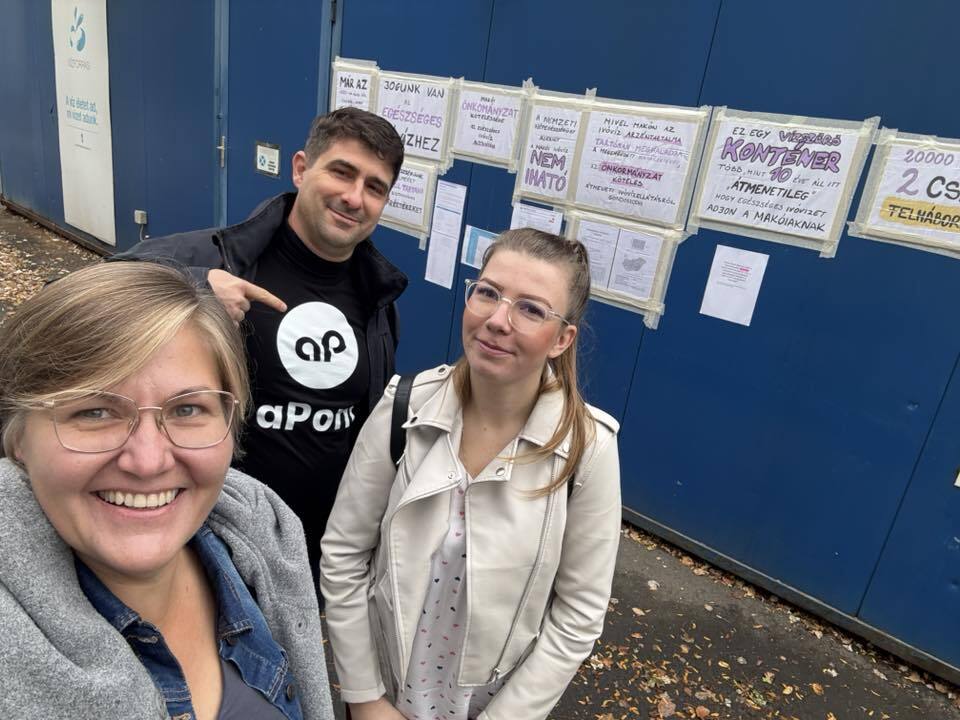
In Makó, the local aPoint also achieved a tangible victory on animal welfare. Following the petition calling for the dismissal of the municipal animal control officer, activists kept the issue on the agenda in the streets, online, at public hearings, and in every forum available to them.
Their well-organized and persistent work contributed to the eventual termination of the contract of an animal control officer who had failed to treat animals with dignity.
In Szentes, our email campaign and hospital walk succeeded in prompting a response from the hospital operator. Here, too, the goal was clear: to inform and involve patients and local residents, because everyone has the right to have a say in decisions that affect their lives.
Regarding Horváth Mihály Secondary School, our local group launched another petition calling for the principal's dismissal. Our activists spoke with local residents at campaign stands and contacted the relevant offices and state secretaries as well. Although no answers have yet been received, the Szentes community continues to stand firmly with the affected parents and students.
In Szeged, the local aPoint once again stood up for the Wesley school and for Gábor Iványi and his community. The Kecskés railway crossing is also on the agenda; after the awareness-raising action organized there, activists received a great deal of positive feedback, confirming that consistent, courageous action has real power locally too.
We continue the work in Csongrád County — with growing momentum, stronger communities, and deep pride in the activist team that makes all this possible day after day.
"For me, the most defining experiences of these six months were the moments when we could see with our own eyes that our actions have real consequences. We could not have done it alone, but together we could. It is especially motivating to work in this community: the activists' faith, perseverance, and determination give me strength every day. By using the power of publicity and giving issues real visibility, we not only reached people, but decision-makers as well — and in several cases forced them to act. All this fills me with confidence about what comes next. It is clear that we are becoming more experienced in our work, that we are drawing on a growing body of knowledge, and that what we represent together is becoming known to more and more people."
Rebeka Tóth, aHang's Csongrád-Csanád County coordinator
Jász-Nagykun-Szolnok County
The focus of aPoint Szolnok's activity continued to be the fight against the planned electrolyte plant.
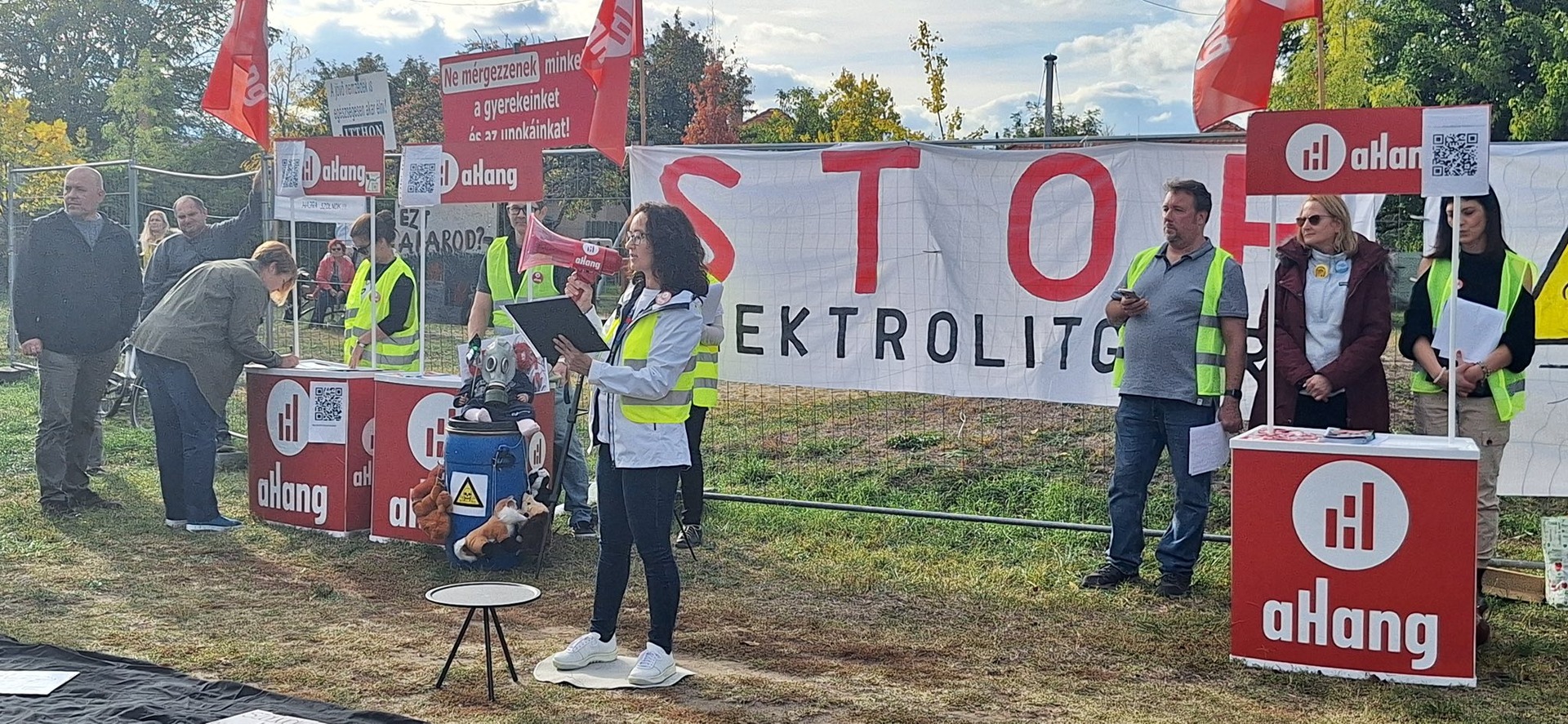
The related petition was handed to the mayor, but the local MP and the ministerial commissioner did not attend the event. So, as the saying goes, "if the mountain will not come to Mohammed": aPoint activists asked their questions at a public forum instead. They received no substantive or reassuring answers, but by the autumn, construction machinery had appeared on the site. The MP still had not spoken about the issue in Parliament, while the mayor told the national press that there was nothing to see. This added fuel to the fire: the aPoint organized a demonstration, preceded by a community banner-painting session. At the public demonstration, alongside speakers from Stop Electrolyte Factory and Akárteis (You Can Too), local residents and community members explained why they do not want an electrolyte plant in Szolnok, and the organizers read out dozens of messages of solidarity from across the country.
Following the demonstration, opposition representatives placed a proposal to ban battery factories in Szolnok on the city assembly's agenda at the end of October. However, the Fidesz majority blocked the initiative by abstaining from the vote. A promise was made to resubmit the proposal, so the aPoint launched an email campaign targeting the representatives who had abstained. By the time of the November city assembly meeting, the city leadership had quietly adopted a symbolic measure behind closed doors, banning a less polluting segment of the battery industry while leaving the electrolyte plant issue unresolved.
aPoint activists also attended county assembly meetings and the city's public hearing, where they read expert opinions into the record. As a result, news of the planned electrolyte plant reached communities across the county. The issue also affected students living in Szolnok's dormitories. After guest workers were housed in a downtown dormitory, students were relocated to the outskirts of the city. In response, the local aPoint launched a petition calling for dignified living conditions for students living in dormitories.
They also organized two civic walks focused on young people and on stopping outmigration. They drew attention to social division and the dangers of exclusion, and visited the Stolpersteine ("stumbling stones") commemorating victims of Nazism. Yet for the roughly four thousand local victims of political incitement and enemy-making, they found only three memorial plaques. They also discussed the renovation of the Abony Road overpass, delayed for ten years; the crumbling Tiszavirág Bridge; Tiszaliget, still without a beach; and problems with public cleanliness. Today, the Tisza Hotel has neither water nor baths: one of Szolnok's greatest assets has fallen prey to politics, power, and money. While a thin slice of society can sip champagne on yachts in the summer, many families in Szolnok — unable to afford a vacation — have little access, in the city of waters, to a decent beach or even a working fountain on hot summer days. For this reason, they launched a petition demanding clean, functioning fountains.
The Szolnok aPoint also took part in national actions, such as the campaign demanding a prime ministerial candidate debate and the anti-propaganda demonstration held to mark the anniversary of Mediaworks' founding.
"For me, the most defining experience of the six months was when, during our civic walk, we caught the ministerial commissioner on his bicycle and spent half an hour pressing him with our questions about the electrolyte plant. I am very proud that our volunteers take proactive action and remain determined in the fight for a livable future."
Ágnes Tollas, aHang's Jász-Nagykun-Szolnok County coordinator
Komárom-Esztergom County
Komárom-Esztergom County also became involved in aHang's work. Over the past six months, local communities across the county have shown that when it comes to local issues, decisions cannot be made over people's heads.
In Tatabánya, the local Facebook page was launched and quickly became an important mobilization platform. The local group joined the central campaign calling for a prime ministerial candidate debate with campaign stands on two occasions, September 15 and October 25. In Tata, the petition "The Tata Castle Moat Belongs to the People of Tata — and Is Not for Sale" was launched, sending a clear message that public heritage should not be treated as a commodity.
In Esztergom, local activists joined the prime ministerial candidate debate campaign with a campaign stand on September 25, and then launched the petition "Do Not Cut the Danube Off from Esztergom." The initiative draws attention to the negative consequences residents face when flood protection infrastructure is planned without community involvement. On November 26, the county community also joined the anti-propaganda day of action.
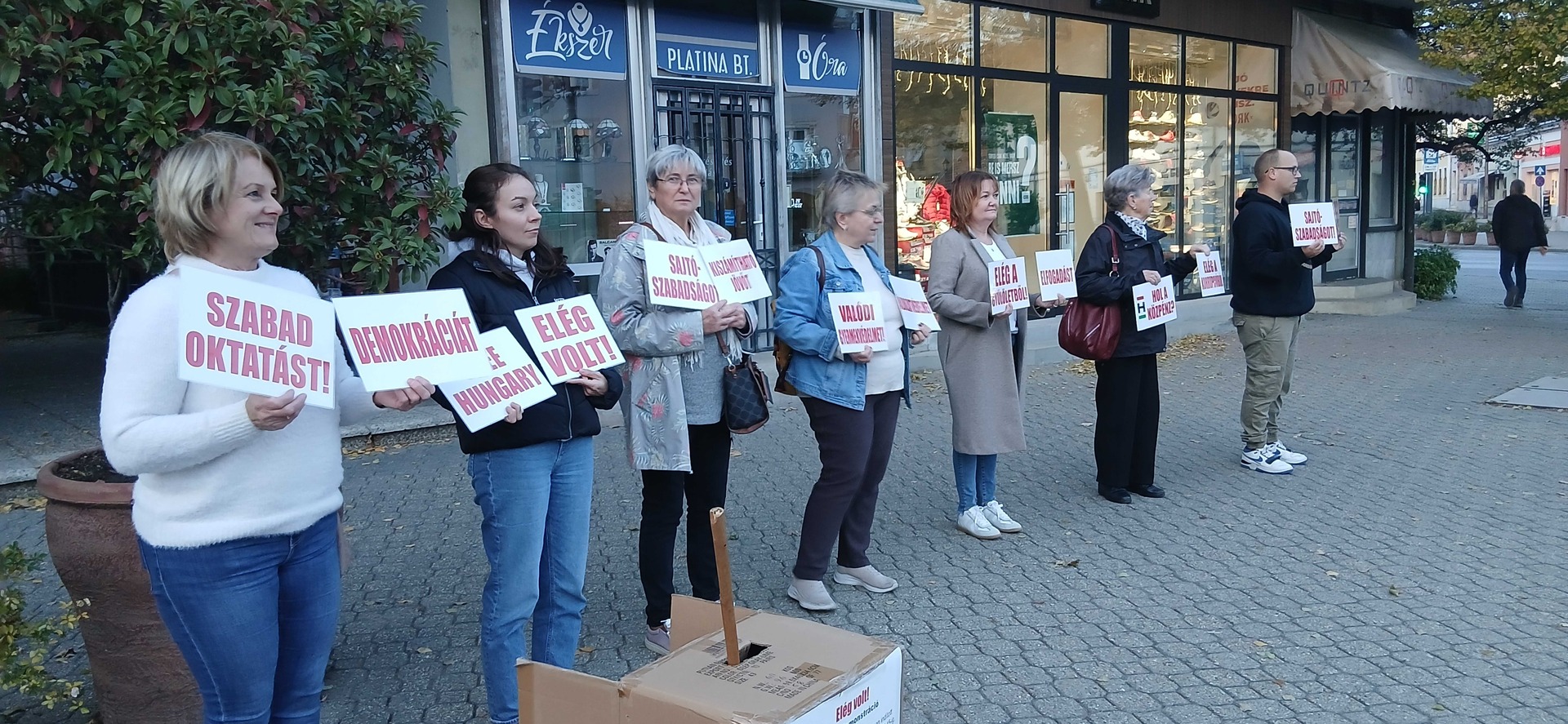
In Komárom, particularly strong community action took shape. The petition "Do Not Transport Battery-Industry Wastewater from Debrecen to Komárom!" was launched, and aHang's local group held a public meeting and continues to organize protests against the plan. Their message is clear: decisions of this scale cannot be made without asking local people. On November 30, they organized a public forum, wrote to the company designated to process the wastewater, launched small-group meetings, and created a Facebook group to connect activists. On December 17, they organized another public action to reinforce the message: they will not back down.
"Over these six months, I watched a few imperfect people, united by shared causes, become a community that thinks together and stands up together. Against those who drain our energy, we can win by showing hope and enthusiasm. This is not the time of the flawless, but of the committed. I am glad to be part of it."
Erika Fábián, aHang's Komárom-Esztergom County coordinator
Nógrád County
In Nógrád County, we are active in two communities: Pásztó and Salgótarján. In both places, work has continued over the past six months according to carefully developed action plans. Rather than reacting to problems on an ad hoc basis, we take a long-term approach: we identify local issues, organize communities around them, and consistently put pressure on decision-makers.
One of the most important current issues for aHang's Pásztó group is saving the Kövicses Stream. The stream is more than a natural feature; it is one of Pásztó's symbols and an important part of the town's identity. Its drying up is therefore not only an environmental issue, but also a reminder of what happens to our shared values when we fail to protect them.
The group is following a clear action plan to ensure that the municipality does not rely on occasional, one-off interventions, but instead develops a comprehensive, long-term strategy for restoring the stream. Their goal is simple: to ensure that the Kövicses Stream remains what it has always been.
aHang's Salgótarján group is also working along a consciously built action plan on an issue affecting the whole region. Nógrád County is today one of Hungary's poorest counties; Salgótarján and its surroundings have been in continuous decline for years, and in the past fifteen years no real, future-building intervention has taken place.
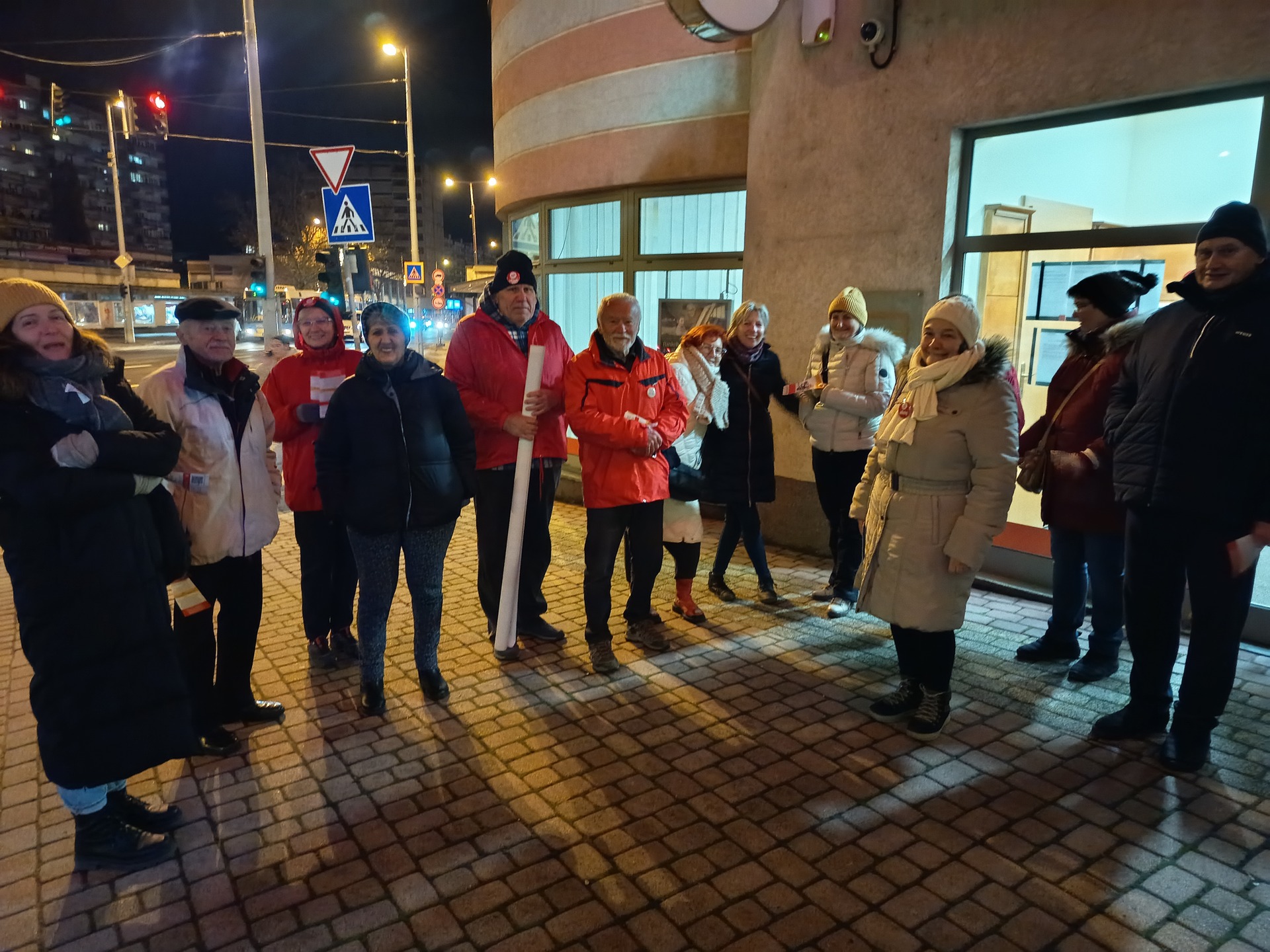
In the view of aHang's Salgótarján group, one key to breaking out is the development of transport. If there were once again a direct railway connection between Salgótarján and Budapest — through the electrification of railway line 81 and modern rolling stock — jobs in Budapest would become accessible, outmigration would decrease, and the whole region could be put on a new development path.
In the second half of 2025, the Salgótarján aPoint met with the leaders of several communities, including the mayors of Salgótarján and Bátonyterenye. Through campaign stands and street campaigning, they gathered the support of more than 3,000 people for the direct rail connection. The issue received national attention: aHang activists personally questioned János Lázár, Minister of Construction and Transport, at a Lázár Info event. He promised improvements to the railway network, although we will consider those promises credible only if they are followed by concrete action.
The railway issue also began to appear in videos and public discussions beyond aHang's own platforms, becoming one of the most important local issues in the region. Politicians have been forced to respond. For now, they are trying to offer partial solutions, such as timetable changes, but it is clear that public pressure is mounting.
"As a coordinator, the most memorable moment of the past six months came when the Salgótarján aPoint attended a theater performance about the railways and, to our surprise, our campaign for a direct rail connection featured prominently in the play. It was an incredible feeling to see an initiative launched by a local community take on a life of its own in public discourse. Seeing an issue we had organized around appear in a cultural space and speak directly to people was both surreal and deeply affirming. For me, it was one of the strongest confirmations of the value of organizing work."
Tibor Köcse, aHang's Nógrád County coordinator
Pest County
aHang began building its presence in Pest County in July 2025. Compared with other counties, it presents unique challenges: the county is highly fragmented, includes many nationally significant local communities, and many of its towns function as commuter hubs for Budapest while also being affected by the capital's gravitational pull.
Against this backdrop, aPoint Dunakeszi was established in the autumn in one of Pest County's largest towns. The group brought together volunteers not only from Dunakeszi itself, but also from nearby communities such as Fót, Göd, Sződliget, Vác, and Veresegyház, as well as from farther afield in Pest County, including Bag, Perőcsény, Érd, and Remeteszőlős.
Thrown in at the deep end, their first action was to join our national campaign calling for a prime ministerial candidate debate ahead of the parliamentary elections. As part of our International Day of Democracy action, activists from aPoint Dunakeszi collected signatures in support of the debate at one of 30 locations across the country. Throughout the autumn, they also set up campaign stands in Dunakeszi and Vác, gathering support both for the debate petition and for our petition calling for a full-scale OSCE election observation mission.
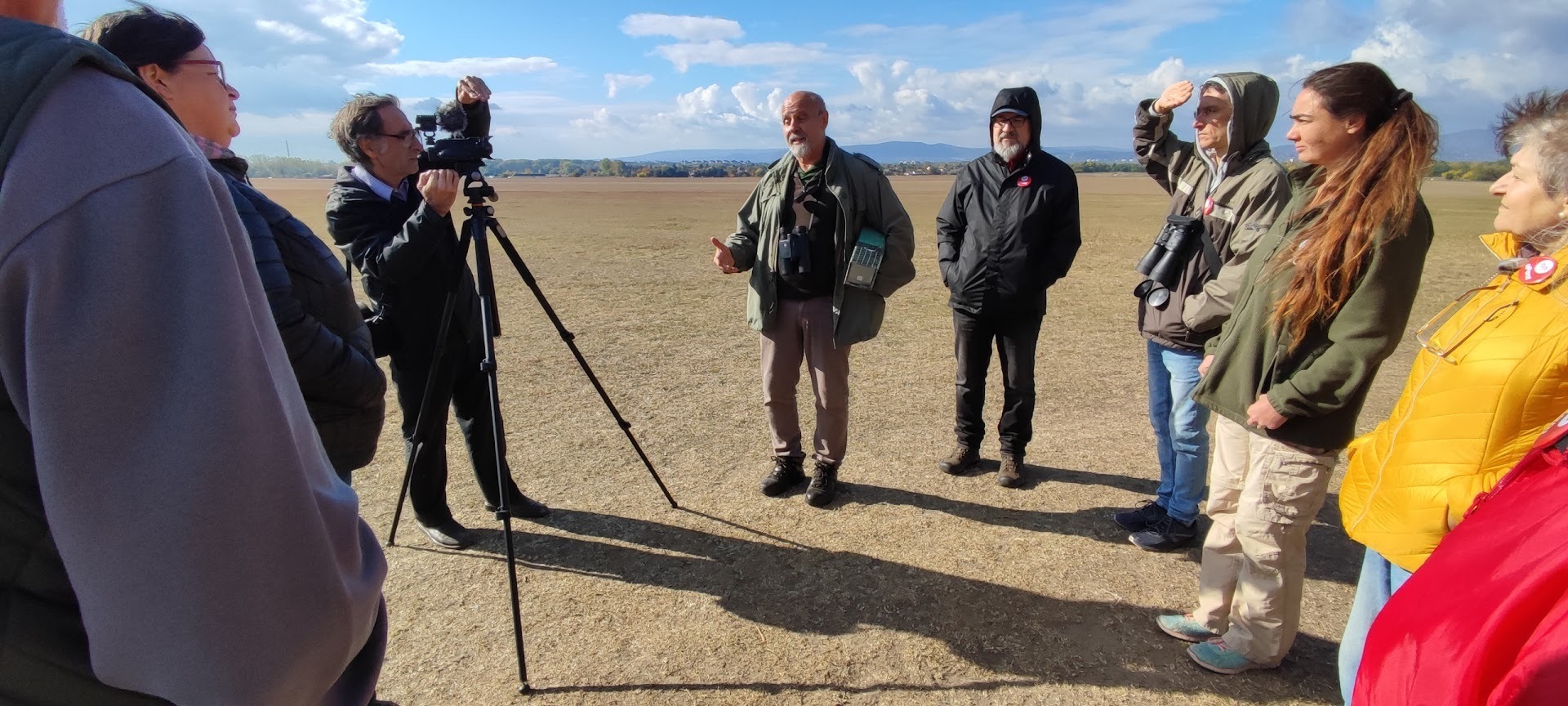
Meanwhile, our Pest County group also took on an important local issue. They launched a petition and local campaign against plans to build on part of the Dunakeszi sport airfield, and to protect the nearly 3,000 strictly protected ground squirrels living there. At their on-site event, titled "FÜRGE ÜRGE (SWIFT SQUIRREL)... and Ecosystem Services," they hosted conservation experts to engage local residents in an educational conversation about the ecological role of one of Hungary's most significant endangered ground squirrel populations, and about the natural value of the airfield, which is part of the national ecological network. To engage younger generations, they also organized a ground-squirrel-themed quiz and paper-airplane folding at the windy and cold, but all the more exciting, event. To prepare the next steps of the campaign, they are planning an expert meeting with organizations connected to the affected area.
Several of our Pest County activists attended a Budapest torchlight demonstration in support of Gábor Iványi in November, as well as a December demonstration in Budapest for children growing up in state care.
One more national action also fit into this short autumn period. On November 26, as part of our national anti-propaganda day of action marking Mediaworks' 12th birthday, aPoint Dunakeszi organized a public action in front of the local Fidesz office under the title "Enough of the Propaganda!" — for peaceful public discourse and credible information. During the flash mob, they asked people in Dunakeszi what they would like to read and hear in local and national media, then handed the residents' answers — tied with a red ribbon as a gift for Mediaworks — to a representative of the local Fidesz office.
"I am very proud of the activists of aPoint Dunakeszi, not only because we managed to build an effective team in such a short time, but also because, sparing neither time nor energy, they immediately threw themselves into current national and local issues. Our local visibility is, of course, still limited after only a few months, but the cooperation, cohesion, and mutual support within the group are such important values that will surely earn the trust and support of the people of Dunakeszi over time. If we can show that by joining forces, people can make decision-makers listen to the needs of local residents and respect the interests of nature, then our work has not been in vain."
Ágnes Magyar-Ábel, aHang's Pest County coordinator
Szabolcs-Szatmár-Bereg County
In the second half of 2025, the number of communities in Szabolcs-Szatmár-Bereg County with an aPoint presence tripled. aPoint Nyíregyháza, founded on November 27, 2024, was joined less than a year later, on November 20, 2025, by two new groups: aPoint Záhony and aPoint Kisvárda. This growth did not come out of nowhere: two very different paths led to the creation of the new groups.
The organizing process in Záhony had already begun in January 2025. A series of group briefings and personal conversations led local activists to join aHang's national campaigns in Budapest, represent them locally, and support the actions and issues of the local aPoints in Nyíregyháza and Miskolc. By the middle of the year, some of them had completed the first activist training held locally.
Even before the training, they had launched their first petition, calling for low-floor trains on the Nyíregyháza–Záhony line, and had already handed it over to the responsible minister. They had to do this two more times before handing it over for a fourth time, on December 5, to MÁV's senior leadership at the Ministry of Construction and Transport.
Thanks to persistent street campaigning and handing over the petition repeatedly, the initiative was finally crowned with success on December 23, 2025. From January 5, 2026, low-floor trains began running three times a day on railway line 100 between Záhony, Nyíregyháza, and Debrecen, ensuring equal access for people with reduced mobility or health limitations, as well as for those traveling with small children or large luggage.
In addition to bringing issues into public life, our activists took part in aHang's summer and winter national gatherings and completed the second training as well. As a result, the Záhony aPoint was founded on November 20 with three members. The group is expected to soon grow by two more full members.
aPoint Kisvárda is more of an issue-based group. Activists had already been present in the community through street campaigning and issue-based actions, but the group truly came together when the social media group "Something Stinks in Várda" was created.
The campaign is still taking shape, and the activists are learning organizing through national and county-level campaigns. They stood up locally and in the county seat for free media, organized street campaigning against politicians' luxury spending, for a prime ministerial candidate debate, and for low-floor trains. After completing aHang's activist training, they founded aPoint Kisvárda on November 26, 2025.
aPoint Nyíregyháza and its activists continue to fight for local people to get a fuller picture of battery plants and related battery-industry investments. They are working to lift the veil of secrecy, put an end to evasive communication, and ensure that an online portal is created where all information is easily accessible, jointly operated by the city, the plants, the supervisory authorities, and civil society organizations. This year's greatest success was the joint, all-day action on battery production, which aPoint Nyíregyháza organized together with the Nyíregyháza Green Action Group and Mothers of Mikepércs for the Environment.
In addition, our Szabolcs-Szatmár-Bereg County groups also help bring national issues to the local level.
"Securing low-floor trains may be the greatest achievement of the year. But for me, the greatest experience has been seeing volunteers cooperate and support one another's causes. This mutual respect and commitment to the cause are why I am with them anytime, anywhere."
Zsolt Jakab, aHang's Szabolcs-Szatmár-Bereg County coordinator
Veszprém County
In the second half of 2025, the Veszprém aPoint focused primarily on bringing national campaigns to the local level and keeping a particularly important, long-running transport issue on the agenda. Local volunteers used creative, playful tools to engage people in conversations about public issues, while in several cases also achieving broader visibility and active participation.
During this period, the Veszprém aPoint joined several national campaigns. They presented the national petition calling for wealth investigations in a playful local format, creating an accessible way to talk about holding oligarchs and front men accountable. During their street campaigning, many people stopped, asked questions, and were open to thinking about systemic corruption.
On the International Day of Democracy, the Veszprém aPoint drew attention to the lack of political dialogue with a spectacular and unconventional action. They took 3D-printed statues of Péter Magyar and Viktor Orbán into the street, where passers-by could ask them questions as if a prime ministerial candidate debate were taking place. The action was both eye-catching and thought-provoking, and sparked many conversations about what a real public political debate would look like in Hungary.
One of the key issues of the six-month period was the renovation of the Veszprém–Ajka railway line. The Veszprém aPoint launched its own petition demanding that the project finally move forward. The leader of the Veszprém aPoint also created a game for the campaign, in which the player has to build a railway line while removing puddles from the tracks, illustrating the current condition of the line and the problems passengers face. The creative approach helped bring the issue to a wider audience.
The Veszprém group hosted the Clean Vote workshop discussion, which drew a full house. The strong interest was clear feedback that in Veszprém and the surrounding communities there is a serious need for credible information and discussion about election integrity, citizens' rights, and opportunities for participation.
Overall, aHang's Veszprém County group further strengthened its presence over these six months and has grown increasingly confident in using creative tools that both reach people and bring real public issues to the surface. The group's activity and successful events show that the county aPoint is building on solid foundations and has a good chance of involving even more local people in aHang's work in the coming period.
"The most interesting, motivating, and funniest experience of these six months was the anti-propaganda demonstration in November. When we arrived at the site, we found that a Ferris wheel was being built exactly where the demonstration was supposed to take place, so at the last minute we had to find a new location, inform people, and prepare. In addition to the members of the Veszprém aPoint, citizen groups arriving for the event immediately joined in to help — and I cannot thank them enough for that."
Fanni Havay, aHang's Veszprém County coordinator
Closing Words
Closing Words
Those in power try to create parallel realities, but our work proves again and again that from Győr to Bicsérd, from Záhony to Orosháza, we face the same problems and difficulties: livelihoods, corruption, our health and our healthcare, and the fact that decision-makers do not hear our voices and have drifted away from reality — from our reality.
In this situation, our responsibility is to show that change is within reach, and that we achieve it when we come together, when we refuse to be intimidated, when week after week, day after day, we stand up — behind an aHang campaign stand, on the stage of a demonstration, at a public hearing, or in a ministry negotiation — and speak with clear, strong arguments to convince those in power: we deserve better.
In the election campaign, too, we are fighting to preserve reality and normality. We refuse to accept people being spoken about in an undignified way, even when the person doing so holds one of the highest offices in the country. We refuse to accept that a narrow political and economic elite — let us say it out loud — has plundered the country, depriving us of a healthy working environment and even clean drinking water; that instead of fixing crumbling healthcare, they spend on fearmongering advertisements; that they have made us leaders in corruption and care more about appearances than people.
Whatever the result of the elections may be, we, aHang, together with you, will remain. This is not a threat; it is responsibility and a promise.
Enikő Tóth, Campaign Director of aHang
Support our work!